

LLC paperwork with PO Box and physical address documents on office desk
Can I Use a PO Box for My LLC Address?

Content
Content
Setting up an LLC forces you to juggle several different addresses, and it's not always clear which ones accept PO Boxes and which don't. You'd think the postal system would work everywhere, right? Unfortunately, LLC address rules are messier than that—what flies for receiving your electric bill won't necessarily work for state filings or legal paperwork.
Here's the deal: whether you can use a PO Box depends entirely on what that address is for. Your LLC doesn't just have one address—it has several, each with its own rulebook. Mix them up, and you're looking at rejected paperwork, wasted fees, and potential compliance headaches.
Understanding LLC Address Requirements
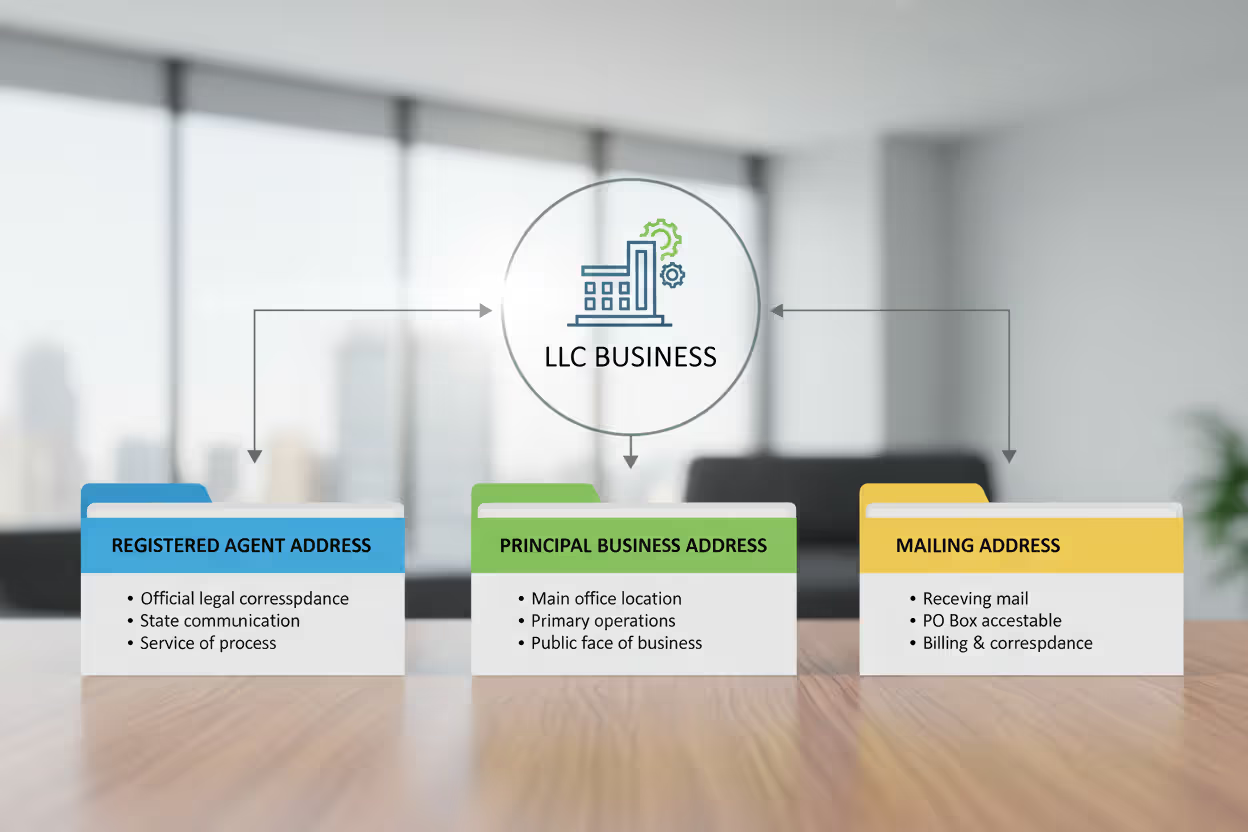
Here's where things get tricky. Your LLC needs three distinct addresses, and treating them as interchangeable is where most people stumble.
Let's start with your registered agent address. This is the location where lawsuit papers, government notices, and other time-sensitive legal documents get delivered. States require a physical street location here—no exceptions. Why? Because when someone serves your business with legal papers, they need to hand those documents to an actual human being at a verifiable location. Every state mandates that this person (or company) remains available weekdays, typically 9-to-5. A PO Box doesn't cut it because there's no one standing by to receive service of process.
Next up is your principal business address, sometimes called your principal office or main business location. This tells the state (and anyone searching public records) where your company actually operates. When you file your formation paperwork, this field almost always demands a real street address. States want to know where you're doing business, not just where you pick up mail.
Then there's your mailing address—the most flexible of the bunch. This is simply where you want routine stuff sent: tax forms, vendor invoices, bank statements, random business correspondence. Here's the good news: you've got options. A PO Box works perfectly fine for this purpose in most situations.
Author: Daniel Whitlock;
Source: worldwidemediums.net
Why does this matter? Because the Secretary of State, IRS, your bank, and licensing agencies all look at these addresses differently. What works on your business cards won't necessarily fly on your Articles of Organization. The distinctions seem bureaucratic and annoying (because they are), but they exist for specific legal reasons around service of process and regulatory oversight.
When You Can Use a PO Box for Your LLC
A PO Box shines when you're handling everyday mail. Running your LLC from home and want to keep business mail separate from your kids' college acceptance letters? Rent a box. It'll cost you maybe $60-120 annually at USPS, depending on size and location.
The IRS is perfectly happy receiving mail at PO Boxes. When you fill out Form SS-4 to get your EIN, you'll notice separate lines for your business location versus where you want correspondence sent. That second line? PO Box away. The IRS will ship your EIN confirmation letter, tax notices, and future correspondence wherever you specify.
State tax departments generally follow the same logic. Whether you're registering for sales tax permits in California or franchise tax accounts in Texas, they'll send renewal notices and tax forms to a PO Box without complaint. Just don't confuse this with your physical business location—those are different fields on the forms.
Once you've established relationships with banks and suppliers, most will accommodate PO Box mailing addresses. After you've proven your LLC exists with formation documents and a real location, ongoing statements and invoices can route wherever is convenient. Some business owners keep everything organized by directing all vendor mail to one box.
The pattern becomes clear: PO Boxes handle mail delivery beautifully. They just can't stand in for physical locations when legal, regulatory, or verification requirements demand an actual place.

Author: Daniel Whitlock;
Source: worldwidemediums.net
When You Cannot Use a PO Box for Your LLC
No state in America allows a PO Box for your registered agent address. Zero. None. Not happening.
Why such a hard line? Legal service of process needs certainty. When someone sues your LLC, they hire a process server who physically hands documents to your registered agent. That exchange creates a legal record with timestamps and signatures. You can't serve a mailbox—you serve a person at a street address. States recognize that PO Boxes might sit unchecked for days or weeks, creating unacceptable delays in urgent legal matters.
Your Articles of Organization will get bounced back if you try listing a PO Box as your principal business address. I've seen this happen to clients who assumed "address" meant any address. They paid their $100-200 filing fee, waited three weeks, then received a rejection letter explaining they need a physical location. They had to re-file, pay again, and wait another three weeks. The state doesn't refund fees for mistakes.
Business licenses often carry the same restriction, especially if inspections are involved. Try getting a food service license with a PO Box and see how far you get. Health inspectors need somewhere to inspect. Contractor licenses, professional licenses, childcare permits—these all demand verifiable physical premises.
Opening a business bank account? Bring a real address. Federal banking regulations require financial institutions to verify business locations as part of their Know Your Customer (KYC) obligations. The bank needs to confirm your LLC operates at an actual location, even if that location is your kitchen table. After the account exists, sure, have statements mailed to a PO Box. But that initial verification requires a street address.

Author: Daniel Whitlock;
Source: worldwidemediums.net
Commercial insurance, vendor credit applications, and lease agreements operate similarly. These involve contracts where the other party has legitimate reasons to verify you're established at a real location. Liability insurance, for instance, needs to assess physical risk. That's impossible with a mailbox.
State-by-State PO Box Rules for LLCs
Every single state draws the line at registered agents—that's universal. Physical address required, no wiggle room.
Beyond that? It gets patchwork-y. California, Texas, Florida, New York, Illinois—the big players all follow a similar template. Your formation documents need physical addresses for registered agents and principal offices. Many of these states include optional mailing address fields where you can list a PO Box separately, but you'll notice the main address fields explicitly say "street address only" or "no PO Boxes."
Delaware loves LLCs (it's literally a cornerstone of their economy), but even the nation's incorporation capital requires physical registered agent addresses. Where Delaware gets flexible is in ongoing reporting—their annual reports and tax filings accept various address configurations more readily than formation documents do. Thousands of Delaware LLCs use registered agent services with Wilmington addresses while operating entirely in other states.
Wyoming and Nevada market business-friendly environments, which mainly translates to low fees and simple paperwork, not PO Box permission. Both states mandate physical registered agent addresses just like everyone else. Their "flexibility" means less bureaucracy overall, not different address rules.
Some states let you split hairs between different address fields on the same form. You might find "principal office address" on line 3 (physical required) and "address for state correspondence" on line 7 (PO Box acceptable). Missing this distinction is easy when you're rushing through paperwork, but it causes rejections.
A few states have gotten picky about differentiating between USPS PO Boxes and commercial mailbox services. They might require you to write "PMB" (Private Mail Box) instead of "Suite" when using a UPS Store address, or they might reject addresses that look like PO Boxes in disguise.
Bottom line: plan on having at least one legitimate physical address in whichever state you're forming. You won't escape this requirement, though creative approaches (which we'll cover next) can minimize privacy exposure.
Alternatives to Using a PO Box for Your LLC
Virtual office addresses rent you a real street address without requiring you to rent actual office space. Companies like Regus, Davinci Virtual, and Alliance Virtual Offices charge roughly $50-300 monthly depending on location prestige and service level. You get a legit street address for business filings, mail forwarding, and often the ability to book conference rooms occasionally. This address appears on public records, but your home stays private.
Registered agent services specifically solve the registered agent problem. For about $100-300 per year, companies like Northwest Registered Agent, Incfile's registered agent service, or Rocket Lawyer provide a physical address in your formation state and handle legal document receipt. When someone serves your LLC, they receive it, scan it, and immediately email you. Especially valuable if you're forming in Delaware or Nevada while living in California—you need a local registered agent, and services make that effortless.

Author: Daniel Whitlock;
Source: worldwidemediums.net
Commercial Mail Receiving Agencies (think UPS Stores, PostNet, Pak Mail) give you addresses that look like apartments or suites—something like "789 Oak Street #234." Unlike obvious PO Boxes, CMRA addresses resemble regular street addresses. They cost $15-40 monthly typically. The catch: states and agencies have started catching on. Some explicitly prohibit CMRAs where physical presence matters, so you'll want to verify this works for your specific situation before committing.
Your home address works fine legally and costs nothing extra. The tradeoff? It's public record. Anyone searching your state's business registry can see it. For home-based consultants, freelancers, and service providers, this is often acceptable. You're not exactly hiding—clients know you work from home. But if privacy concerns you (maybe you work in a sensitive field, or you've got safety worries), paying for privacy through one of the above options makes sense.
Some people use a family member's house or friend's business address with permission. This technically works as long as you genuinely have access to receive mail there and they're reliable about forwarding time-sensitive documents. The risk: if that person moves, becomes unreachable, or the relationship sours, you've got an address problem at the worst possible time.
Which solution fits depends on your budget, business type, and privacy needs. A one-person consulting LLC might accept home address publicity to save $300 yearly. An online business with no physical location might invest in a virtual office for credibility and privacy. There's no universal right answer.
How to Set Up Your LLC Address Correctly
Before touching your Articles of Organization, nail down your registered agent situation. Will you serve as your own agent using your home or office address? Or hire a service? If you're going the service route, sign up first. You'll need their address ready when filling out state paperwork.
When you're staring at your state's formation forms, slow down and read each address field's instructions. Look for labels like "registered office," "principal place of business," "main business location," and "mailing address." These aren't synonyms dressed up in different words—they're legally distinct. Enter your registered agent's physical address in the registered office field. Your actual business location goes in the principal address field. If there's a separate mailing address option, that's where a PO Box becomes acceptable.
After your state approves your LLC (usually takes 1-3 weeks, faster if you pay expedite fees), grab your EIN from the IRS. Form SS-4 asks for a "principal business address" and separately asks where to send your EIN letter. Physical address goes in the first field. Your PO Box (if you have one) works for the second.
This is when you'd set up that separate mailing address if you're using one. Rent your PO Box at USPS, sign up for that virtual office, or establish your CMRA account. Then notify the IRS of your mailing address preference using Form 8822-B. State tax agencies typically let you update mailing addresses through online portals—look for "change business information" or similar options.
Here's something nobody tells you: create a spreadsheet tracking which address you've given to which entity. Seriously. Put four columns: registered agent address, principal business address, mailing address, and PO Box (if applicable). Then rows for IRS, state tax agency, business licenses, bank, insurance company, major vendors. Update this whenever anything changes. Future you will be grateful when it's time to file amendments or update addresses after moving.
When opening your business bank account, bring documentation showing your physical business location—usually your Articles of Organization work fine. Most banks will then let you designate a different mailing address for statements. Just clarify this during account setup.
Common Mistakes When Using PO Boxes for LLCs
I've seen business owners lose lawsuits they didn't even know existed because they used invalid registered agent addresses.Someone sues the LLC, serves papers to a PO Box address that isn't checked regularly, and by the time the owner discovers the lawsuit, default judgment has already been entered. At that point you're fighting uphill to set aside the judgment—way more expensive than just using a proper address from day one. If privacy matters to you, spend the $125 annually on a registered agent service. It's the cheapest insurance policy you'll never regret buying
— Marcus Chen
The costliest error? Listing a PO Box where your registered agent address should go. This tanks your formation filing immediately. The state sends everything back, keeps your filing fee, and you start over. I've watched business owners lose $300+ in fees and expedite charges because they didn't read the form carefully.
Many people see "address" on their Articles of Organization and assume any address works. They spot one field, plug in their PO Box, submit, and wait. Three weeks later: rejection. The form actually had separate fields—they just didn't notice that Line 4 said "street address only" in small print. Always read field-specific instructions, not just the general form directions.
Moving your business or changing registered agents without filing amendments creates disasters. States send annual report reminders, tax notices, and compliance warnings to your registered agent address. Miss these because you moved and forgot to update? Your LLC gets administratively dissolved. Then you're paying reinstatement fees ($50-500 depending on state) and penalties, plus dealing with business interruption. File a Statement of Change or Amendment within 30 days of any address change.
Some entrepreneurs think a PO Box offers bulletproof privacy protection. Not quite. Your registered agent and principal business addresses live on public records regardless—anyone can search your state's business database and find them. A PO Box only keeps your home address off business cards and shields your personal mailbox from business clutter. Real privacy requires registered agent services or virtual offices for your publicly filed addresses, with PO Boxes as a supplementary tool.
Tax form address mixups create processing delays you don't need during tax season. When a form asks "Where is your business located?" that's asking for physical location. When it asks "Where should we mail this?" you can use a PO Box. These seem similar but they're not. The IRS system processes addresses based on field-specific coding, and entering the wrong type triggers verification holds.
Using someone else's address without solid, documented permission creates legal exposure. Say you list your brother's address as your registered agent location without formal agreement. He receives a lawsuit on your behalf but forgets to tell you for two weeks. You've potentially missed response deadlines, risking default judgment. Only use another person's address with written authorization and absolute trust in their reliability.
LLC Address Types and PO Box Rules
| Address Type | What It's For | PO Box Acceptable? | Important Details |
| Registered Agent Address | Legal papers, lawsuit service, government notices | Never | Must be physical street address with business-hour availability in your LLC's state |
| Principal Business Address | Shows where LLC operates; appears on formation documents | Rarely | Almost all states require physical street address on Articles of Organization |
| Mailing Address | Routine correspondence, bills, tax forms, vendor mail | Yes | Most flexible option; accepted by IRS, state agencies, banks for ongoing mail |
| IRS Address (Form SS-4) | Tax correspondence and notices | Yes (for correspondence field) | Physical address still required for business location field on same form |
Frequently Asked Questions
PO Boxes handle mailing addresses beautifully but can't substitute for the physical addresses states require for registered agents and principal business locations. The trick is matching the right address type to the right purpose and following your specific state's requirements.
Before filing LLC paperwork, secure a physical address for your registered agent and principal business location—whether that's your home, an office, or a registered agent service. Then set up a PO Box separately if you want mail privacy or organizational convenience. This satisfies legal requirements while giving you control over mail flow.
Getting addresses right initially costs less than fixing mistakes later. Rejected filings waste $100-200 in fees. Missed legal notices because of invalid addresses can cost thousands in default judgments. Administrative dissolution from outdated addresses means reinstatement fees and business disruption. Compare that to maybe $125 annually for a registered agent service or $30 monthly for a virtual office—prevention wins economically.
Check your LLC's address situation once yearly as part of routine compliance. Confirm your registered agent information remains current with the state, verify your IRS mailing address is correct, and ensure you're reliably receiving mail at all designated locations. This simple annual review prevents the cascading problems that occur when important government notices vanish into outdated addresses.
Related Stories

Read more

Read more




The content on this website is provided for general informational and educational purposes only. It is intended to explain concepts related to Limited Liability Companies (LLCs), including formation, management, taxation, compliance, and business structuring.
All information on this website, including articles, guides, templates, and examples, is presented for general educational purposes. LLC requirements and regulations may vary depending on individual circumstances, business activities, state laws, and jurisdiction.
This website does not provide legal, tax, or financial advice, and the information presented should not be used as a substitute for consultation with qualified legal, tax, or financial professionals.
The website and its authors are not responsible for any errors or omissions, or for any outcomes resulting from decisions made based on the information provided on this website.