

Business owners reviewing LLC ownership documents at a meeting table
How to Change Percentage Ownership in LLC?

Adjusting who owns what percentage of your LLC isn't just paperwork—it's a legal process that can trigger tax bills, state penalties, and partnership disputes if you cut corners. Maybe you're adding a partner who's bringing $200,000 to the table, or a co-founder is leaving and you need to redistribute their 40% stake. Either way, you'll need to navigate operating agreement amendments, member approvals, IRS notifications, and capital account recalculations.
Getting this right the first time saves you from costly fixes later. I've seen business owners try to formalize ownership changes years after the fact, only to discover they owe back taxes or face member lawsuits over distributions that didn't match outdated percentages.
Understanding LLC Ownership Structure
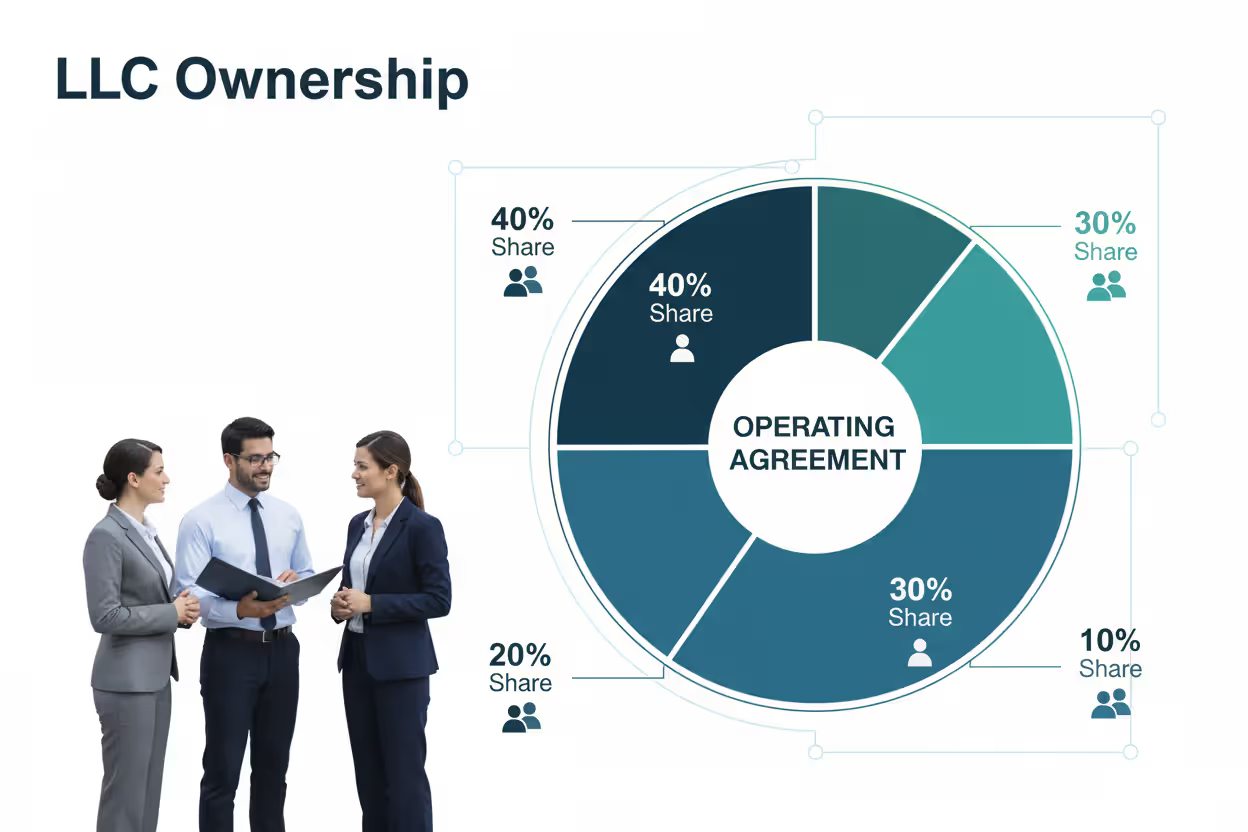
Think of LLC ownership as slices of a pie that always equals 100%. Your slice determines your cut of profits, losses, and what you walk away with if the company sells or closes. These aren't stock certificates like corporations use—they're membership interests tracked as percentages in your operating agreement.
When you first form your LLC, the operating agreement locks in who owns what based on initial investments. Put in $70,000 while your partner contributes $30,000? You'll typically start with 70% ownership, they get 30%. But here's what trips people up: llc ownership percentages explained properly means understanding they're just one piece of the puzzle.
Ownership doesn't automatically give you voting power. Your operating agreement might say the 20% owner gets equal say in decisions as the 60% owner. Or it could give someone veto rights over specific choices regardless of their equity stake. I've worked with LLCs where a 15% owner controlled hiring decisions while the 50% majority owner focused on financial strategy.
Capital accounts add another layer that confuses new members. Your ownership percentage might stay locked at 35%, but your capital account—think of it as your running investment total—changes constantly. Company makes $100,000 in profit this year? Your capital account increases by $35,000. Take a $20,000 distribution? It drops by that amount. These accounts matter enormously when someone exits or you're calculating buyout prices.
Different membership classes create even more flexibility with llc equity percentage structures. Class A members might get paid first from profits, while Class B members control day-to-day operations. You could have non-voting members who just collect distributions, or voting members with minimal financial stake. The operating agreement defines these distinctions, which is why "membership interest" is more accurate than "ownership" in most LLC contexts.
Author: Kevin Halbrook;
Source: worldwidemediums.net
Reasons to Change LLC Ownership Percentages
Business partnerships rarely stay static. Here's when ownership split in llc arrangements typically need adjusting.
Bringing in fresh capital often means diluting existing ownership. Your three-person LLC splits ownership 33.3% each, but now you need $150,000 for equipment. A new partner contributes that cash for 30% ownership, which drops everyone else to about 23.3%. Or maybe existing members contribute proportionally to maintain their percentages—but if only two of the three can afford it, you're looking at an uneven adjustment.
Sweat equity corrections happen when someone's putting in way more work than originally planned. Your operating agreement gave everyone equal ownership, but one partner is working 60-hour weeks while another contributes 10 hours monthly. After a year, you might adjust ownership to reflect actual value delivered—sometimes retroactively, though that creates tax headaches.
Buyouts and departures force redistribution. When a 25% owner leaves, that stake gets absorbed by remaining members or sold to a newcomer. You might split it evenly among three remaining members (8.33% each), or let the majority owner purchase the entire stake. Estate situations get messy—a deceased member's 40% interest might pass to their spouse who has zero interest in the business, requiring a structured buyout to change llc ownership percentage back to active members.
Performance milestones trigger ownership bumps in startups. A technical co-founder might start with 15% but earn up to 30% by hitting product launch deadlines and revenue targets. These "vesting schedules" for LLC interests require careful documentation with each adjustment.
Debt-to-equity conversions restructure financial obligations. Maybe you owe a member $80,000 for a loan they made to the company. Converting that debt to ownership eliminates the liability but requires increasing their percentage and diluting everyone else. I've seen this approach save struggling LLCs from cash flow crises.
Divorce and legal judgments sometimes mandate ownership transfers. A court might order a divorcing member to transfer half their 50% stake to their ex-spouse, immediately creating a new member and dropping the original member to 25%. These aren't voluntary changes, but they follow the same formal process.
Steps to Change Ownership Percentage of LLC
Here's your roadmap to change ownership percentage of llc interests without creating legal or tax problems.
Review Your Operating Agreement
Pull out your operating agreement and read the amendments section—probably near the end if you used a standard template. You're looking for what approvals you need, how to value interests being transferred, and any restrictions on who can own membership interests.
Some agreements require every single member to approve ownership changes. Others allow modifications with 75% or two-thirds majority. A few even let managers make certain adjustments without member votes, though that's rare and usually limited to minor tweaks.
Watch for right-of-first-refusal clauses. These give existing members first dibs to purchase any interest before it goes to outsiders. Violate this provision and your transfer might be void, creating a mess with someone who thought they'd joined your LLC.
Transfer restrictions might block sales to competitors, require members to offer their interests to the company first, or mandate specific valuation methods. One client discovered too late that their agreement prohibited transfers to family members without unanimous approval—right after giving 15% to their daughter.
No operating agreement, or yours is silent on amendments? Most state default rules require unanimous consent for ownership transfers. You're essentially starting from scratch, which means drafting these provisions before you can proceed with your changes.

Author: Kevin Halbrook;
Source: worldwidemediums.net
Secure Written Approval from Every Member
Verbal agreements mean nothing when someone's distribution check is smaller than they expected. Get signatures on paper (or verified electronic signatures) from everyone whose approval your operating agreement requires.
Draft a consent document that's crystal clear: "We, the undersigned members of ABC Consulting LLC, consent to changing ownership percentages from the current structure of Jane Doe 50%, John Smith 30%, Sarah Johnson 20% to the revised structure of Jane Doe 40%, John Smith 30%, Sarah Johnson 20%, Robert Williams 10%, effective March 1, 2026."
Include the reason for the change, especially if money's changing hands. "Robert Williams is purchasing 10% ownership from Jane Doe for $45,000" tells a clear story. Document any payment terms, adjustment timelines, and what happens to voting rights alongside the ownership shift.
Have members sign and date in front of a notary when you can. Notarization isn't legally required in most states for internal LLC documents, but it makes challenging the consent much harder later. For major changes—anything over 20% ownership or involving members leaving—notarization is worth the $15 per signature.
Members spread across different states? Use a verified e-signature platform like DocuSign or Adobe Sign that complies with the Uniform Electronic Transactions Act. Email confirmations and text messages don't cut it for legal documentation. Get proper digital signatures with audit trails showing when each person reviewed and signed.
Amend the Operating Agreement
Your operating agreement amendment needs to reference the original agreement by date, specify what's changing, and spell out the new ownership structure in plain language.
"This Amendment to the Operating Agreement of XYZ Holdings LLC, originally dated January 15, 2023, hereby modifies Article IV, Section 2 (Membership Interests) as follows: Effective April 1, 2026, ownership percentages shall be: [list new percentages for each member]."
Update the capital accounts section simultaneously. If someone's contributing cash to increase their ownership, show both the contribution amount and resulting percentage. "Member B contributes $75,000 to the LLC capital, increasing their capital account from $125,000 to $200,000 and their ownership interest from 25% to 35%."
Address profit and loss allocations explicitly—do new percentages apply to the full year or just from the effective date forward? This determination drastically affects everyone's tax returns. Mid-year changes typically require pro-rata allocations, meaning you calculate each member's share based on how long they held each percentage during the year.
Get every member's signature using the same formality level as your original operating agreement required. If your original had three copies signed in wet ink, do that again. Store the executed amendment in your LLC records binder, send copies to all members, give one to your accountant, and email a PDF to your registered agent.
Update IRS and State Records
The IRS doesn't have a specific "ownership change form" for LLCs taxed as partnerships. Instead, changes flow through your annual tax return via Schedule K-1 forms. Each member's K-1 must reflect their correct ownership percentage for the portions of the tax year they held each level.
Changed ownership in July? Your tax preparer needs to issue K-1s showing the split: Member A owned 30% from January-June and 40% from July-December. They'll allocate income, deductions, and credits proportionally across these periods. Don't try this yourself—partnership tax accounting gets complex fast.
State filing requirements vary wildly. California's Statement of Information (Form LLC-12) requires updates within 90 days of adding or removing members. Skip it and you're looking at $250+ penalties plus potential administrative dissolution. Nevada wants no notification for internal ownership shuffles. Florida requires amended Articles of Organization only if your original filing listed specific member names and percentages.
Check whether your Articles of Organization included member information. Most states don't require this in your formation documents, but if yours listed specific members or percentages, you'll need to file an amendment with your Secretary of State—typically $50-$200 depending on state, often available online.
Single-member LLCs becoming multi-member (or vice versa) trigger entity classification changes for tax purposes. Adding a second member converts a disregarded entity to a partnership for IRS purposes automatically. Notify the IRS by filing Form 8832 if you want to maintain S-corp or C-corp election, or confirm the automatic classification change if you're okay with partnership taxation.
Revise Capital Accounts
Capital account accuracy prevents disputes and tax problems. Each member's capital account tracks their total investment: contributions in, plus allocated profits, minus distributions out, minus allocated losses.
When someone contributes cash to increase ownership, their capital account jumps by the contribution amount. Member C adds $100,000 to increase from 20% to 30% ownership? Their capital account increases by exactly $100,000. Other members' capital accounts stay the same, but now represent smaller percentages of the total.
Ownership transfers between members work differently. Member D sells 15% ownership to Member E for $90,000. Member D's capital account decreases by their 15% portion of total capital accounts (not necessarily $90,000), while Member E's account increases by that same amount. The actual sale price might differ from capital account values—creating capital gains or losses for the seller.
Here's where it gets tricky: if the sale price exceeds the capital account value being transferred, the seller recognizes taxable gain. Capital account transfer is $60,000, but sale price is $90,000? That's $30,000 in capital gains. Your CPA needs to calculate this, not you.
Gifted ownership or ownership received for services creates "book-tax disparities." When Member F receives 10% ownership in exchange for legal services worth $50,000, you increase their capital account by $50,000 (creating ordinary income to them), but the LLC's tax basis in its assets doesn't change. These disparities require tracking separate book and tax capital accounts—definitely hire a professional for this situation.
Document every adjustment with dates, amounts, and reasons. Spreadsheet minimums should show: member name, date of change, type of transaction (contribution, distribution, profit/loss allocation, ownership adjustment), amount, and resulting capital account balance. Most accounting software for partnerships tracks this automatically if set up correctly.
Legal Documents Required to Change LLC Ownership
Gather these documents for your ownership change to survive legal scrutiny and IRS audits.
Amendment to Operating Agreement serves as your primary evidence of the ownership change. Beyond what I covered earlier, include transition provisions if ownership changes gradually (vesting over time), clarify whether new percentages affect existing obligations differently, and confirm whether profit distributions for the current year follow old or new percentages until the effective date.
Member Consent Forms should exist as standalone documents even if members also signed the amendment. These forms prove each member understood what they were approving. Format them as: "I, [Name], consent to [specific change], understand this affects my [distributions/voting/obligations] as follows: [specific impacts], and acknowledge I've had opportunity to consult legal and tax advisors."
Assignment of Membership Interest documents transfers from one member to another (or to the LLC itself during buyouts). Essential elements: assignor's name and current ownership percentage, assignee's name, percentage being transferred, purchase price and payment terms, effective date of transfer, whether voting rights transfer with ownership or stay with assignor (your operating agreement might allow splitting these), and both parties' signatures plus acknowledgment by LLC managers or remaining members.
Bill of Sale or Purchase Agreement backs up assignments when money changes hands. This contract protects buyer and seller by specifying payment schedule (lump sum or installments), representations and warranties (seller owns what they're selling, no liens exist), indemnification provisions if representations prove false, and what happens if buyer defaults on payments.
Updated Schedule K-1s (IRS Form 1065, Schedule K-1) flow from your partnership tax return and must be issued to each member showing their share of income, deductions, credits, and distributions for the year. Mid-year ownership changes require complex allocation calculations—your tax preparer handles this, but you need to provide exact dates and percentages.
State-specific filing forms depend on your jurisdiction. California LLC-12 Statement of Information lists all managers and members. New York's Articles of Amendment modify your original formation documents if those listed member information. Delaware requires nothing for internal ownership changes but your annual franchise tax report should reflect current ownership to avoid questions during audits. Texas Form 811 amends certificates of formation when required information changes.
Valuation reports might be necessary for your records even if not filed anywhere. When ownership transfers at prices differing from pro-rata company value, having a formal valuation prevents IRS challenges that the price was a disguised gift or compensation. Business appraisers charge $3,000-$8,000 for small LLC valuations, but this beats IRS penalties and adjustment notices.
Estoppel certificates confirm key facts for outside parties (lenders, investors, landlords). These certificates, signed by all members, confirm current ownership percentages, that no disputes exist regarding ownership, all contributions required have been made, and the LLC is in good standing. Commercial lenders often require these before approving loans.

Author: Kevin Halbrook;
Source: worldwidemediums.net
Tax Implications of Changing LLC Equity Percentage
Ownership changes trigger tax consequences that catch members off-guard. Here's what you're dealing with.
Capital gains taxes hit sellers when they profit from selling their interest. Your capital account shows $80,000, you sell for $130,000, you've got $50,000 in capital gains. Hold your interest over a year and you'll pay long-term capital gains rates (0%, 15%, or 20% depending on your income bracket for 2026)—much better than ordinary income rates. Sell within a year of acquiring your interest and you're paying ordinary rates potentially up to 37% federal.
But here's the gotcha: LLCs with "hot assets" (inventory, receivables, depreciation recapture) create ordinary income even on long-term holdings. Sell your interest in an LLC that's depreciated $200,000 in equipment? Part of your gain gets recharacterized as ordinary income. Section 751 of the tax code governs this—I'm mentioning it so you can ask your CPA about it specifically.
Gift taxes become an issue when ownership transfers without adequate payment. Give your daughter 20% ownership in exchange for nothing? The IRS treats this as a gift valued at fair market value of that 20% interest. 2026's annual gift tax exclusion is $18,000 per recipient—anything beyond that eats into your lifetime exemption (currently $13.61 million, though this drops to around $7 million in 2026 unless Congress acts). You won't pay gift tax until you've exhausted this lifetime exemption, but you must file Form 709 to report the gift.
Transfers to spouses typically avoid gift tax under the unlimited marital deduction. But transfers to ex-spouses under divorce decrees are treated differently—consult a tax attorney for these situations because timing and documentation affect whether they're taxable gifts, property settlements, or other categories.
Deemed distributions surprise members who aren't receiving any cash. Decrease your ownership percentage and you might trigger taxable income from liability shifts. Here's how: your LLC has $400,000 in debt. You own 50%, so $200,000 of debt is allocated to you on your tax return (affecting your basis). Drop to 30% ownership and only $120,000 of debt allocates to you. The IRS treats that $80,000 debt reduction as if you received an $80,000 cash distribution—creating taxable income even though nothing hit your bank account.
Partnership debt allocation rules under Section 752 create this phantom income situation. It's backwards from what makes intuitive sense, which is exactly why members get blindsided at tax time.
Section 721 contributions allow tax-free property contributions for ownership interests in most situations. Contribute land you've owned for years in exchange for 40% LLC ownership? Generally no immediate tax. But exceptions devour the unwary: contributing property subject to debt exceeding your basis triggers immediate gain, receiving ownership for services rather than property creates ordinary income, and contributing property to an investment partnership (vs. operating business) might not qualify for tax-free treatment.
Section 754 elections offer tax advantages to purchasing members that selling members don't care about. When you buy into an LLC, you're purchasing the seller's share of LLC assets at current fair value—but the LLC's books still show historical cost basis. Make a Section 754 election and the LLC adjusts asset basis for you specifically, giving you higher depreciation deductions going forward. The LLC files this election with your partnership return (Form 1065), and it affects all future transfers, not just the current one.
Downside: Section 754 elections increase accounting complexity and cost. You're tracking each member's capital account on both book and tax basis, with separate adjustments. Small LLCs might pay an extra $1,500-$3,000 annually in tax prep fees after making this election.
Self-employment taxes affect active LLC members receiving income from the business. Ownership percentage changes might shift whether you're considered active or passive for self-employment tax purposes—particularly if your role changes alongside the ownership adjustment. Drop from 60% ownership to 20% and simultaneously step back from daily management? Your self-employment tax situation just changed, and you might owe less (or more, depending on guaranteed payments and profit allocations).
Members typically focus on what percentages they'll own after a change, but ignore what happens between signing and year-end. I've seen ownership adjustments create $40,000 unexpected tax bills from deemed distributions and debt reallocations that nobody calculated beforehand. You're playing with real tax consequences here, not just dividing up a pie differently. Get your CPA to model the tax impact before signing anything—a one-hour consultation costs $300, fixing mistakes after the fact costs thousands
— Marcus Chen
Common Mistakes When Adjusting Ownership Split in LLC
Learn from others' expensive errors.
Informal agreements without documentation rank as the number one disaster I see. Two partners agree over lunch that one will increase to 60% ownership "once we close the Peterson deal." Deal closes, but they never document the change. Two years later, they're in court fighting over whether distributions should follow the old 50-50 split or the new 60-40 arrangement. Memories differ, texts are ambiguous, and legal fees exceed $50,000 before settlement. Put it in writing the day you agree to it.
Skipping the operating agreement amendment happens when members think a separate "transfer agreement" suffices. It doesn't. Your operating agreement controls ownership percentages—if it still shows old percentages while a separate document shows new ones, you've created conflicting records that will haunt you during audits, disputes, or sales.
Tax timing disasters occur when members finalize ownership changes without considering tax year implications. Change ownership on December 30th and you've potentially created a full year's worth of tax allocations at new percentages (depending on how your operating agreement handles mid-year changes). Wait until January 2nd and you get a clean break between tax years. Week's difference, massive tax implications.
Ignoring capital account adjustments makes future distributions a nightmare. Your ownership percentages say 40%, but your capital account suggests 35% because nobody updated it during the ownership change. Which governs distributions? Now you need a forensic accountant to reconstruct three years of transactions, costing $8,000+ to fix a problem that would've taken 20 minutes to handle correctly.
Forgetting state annual report updates means your Secretary of State records show outdated information. Not a problem until you try to sell the company or get a business loan and the title company discovers discrepancies between your internal records and state filings. I've seen closings delayed by 60+ days while members scrambled to file corrective amendments and obtain updated certificates of good standing.
Misunderstanding dilution math creates incorrect ownership calculations. Your LLC has three 33.3% owners. Add a fourth member with 25% ownership—each original member drops to what? Many assume 25% each (incorrect). Actually: add the new 25% member and total ownership before is 100%, after needs to be 100%, so 25% of the new total comes from the new member means... you need to work backwards. New member has 25 of 100 shares, meaning existing 100 shares now represent 75%. Each 33.3 share becomes 33.3 × 75% = 25% each. This math confuses people constantly.
Assuming voting follows ownership automatically leads to governance fights. Changed someone's ownership from 30% to 40% but your operating agreement separates voting rights from economic rights? They still get 30% voting weight unless you also amended the voting provisions. I've watched companies deadlock because members assumed ownership changes carried voting changes along automatically—they didn't.
Not updating buy-sell agreements leaves triggered buyout provisions pointing to wrong percentages or departed members. Your buy-sell agreement says Member A's estate must sell their 35% ownership to remaining members at 3× EBITDA if they die—but Member A now owns 25% after a restructure. Agreement still says 35%, creating confusion about whether the triggered buyout is for 25% or 35%, and whether the old formula still applies.
Comparison of LLC Ownership Change Methods
| Method | Member Approvals Needed | Tax Consequences | State Filing Requirements | Timeline From Start to Finish |
| Direct Sale Between Members | Seller + buyer + others per operating agreement (often unanimous) | Capital gains to seller based on difference between sale price and capital account; buyer's basis equals purchase price; possible Section 754 adjustment | Rarely required; California demands Statement of Information update within 90 days; most states need nothing | 3-7 weeks including valuation, negotiations, documentation, payment processing |
| LLC Buyout of Departing Member | Departing member + percentage specified in agreement (often majority or supermajority) | Capital gains to seller; LLC may face basis adjustments; remaining members' ownership increases proportionally without capital gains; debt reallocation may create deemed distributions | Usually none unless member removal requires state notification per Articles; Texas and California have specific update requirements | 5-10 weeks including valuation disputes, payment arrangements, potential litigation if terms are disputed |
| Additional Capital Contributions | All members if diluting others without their pro-rata contributions; sometimes just contributing members if agreement allows | Generally tax-free under Section 721; debt allocation shifts may create deemed distributions to non-contributing members; complex when property rather than cash is contributed | Not required for capital changes; required if new member joins; varies by state—New York and California typically require updates | 2-5 weeks for existing members; 4-8 weeks if adding new members due to state processing times |
| New Member Admission | Unanimous or supermajority per operating agreement (state default is unanimous if silent) | Depends on what new member contributes (cash, property, services); existing members face dilution without direct tax unless they also contribute; possible Section 83 income if services exchanged for ownership | Required in nearly all states; Articles of Organization amendment if original listed members; annual report updates required in most jurisdictions | 4-8 weeks including state filing processing (expedited options available in some states for additional fees) |
Frequently Asked Questions About LLC Ownership Percentages
Changing your LLC's ownership percentages involves more than updating a spreadsheet—you're executing a legal process with tax implications and state requirements that can cost serious money if handled carelessly. Start with your operating agreement, secure proper member approvals, amend the agreement formally, notify the IRS and state authorities as required, and update capital accounts to reflect the new structure.
The most expensive mistakes happen when members treat this as a casual process or skip professional guidance to save a few hundred dollars upfront. Straightforward ownership changes among friendly partners might not need extensive legal help, but complex situations—significant value transfers, member disputes, multi-state implications, or sophisticated tax structures—benefit enormously from attorney and CPA involvement before you sign anything.
Keep detailed records of every ownership change: the business reasons driving it, what consideration changed hands, supporting valuations, and all executed documents. These records protect you during IRS audits, defend against member disputes, and prove invaluable when you eventually sell or dissolve the LLC. Properly documented ownership changes strengthen your business structure; rushed or poorly recorded changes create problems that surface years later and take considerable time and money to resolve.
Related Stories

Read more

Read more




The content on this website is provided for general informational and educational purposes only. It is intended to explain concepts related to Limited Liability Companies (LLCs), including formation, management, taxation, compliance, and business structuring.
All information on this website, including articles, guides, templates, and examples, is presented for general educational purposes. LLC requirements and regulations may vary depending on individual circumstances, business activities, state laws, and jurisdiction.
This website does not provide legal, tax, or financial advice, and the information presented should not be used as a substitute for consultation with qualified legal, tax, or financial professionals.
The website and its authors are not responsible for any errors or omissions, or for any outcomes resulting from decisions made based on the information provided on this website.