
Small business owner reviewing LLC formation documents with US map on desk
How to Decide What State Should I Form My LLC In?

Here's what nobody tells you upfront: most business owners waste money forming their LLC in the "wrong" state—not because they picked badly, but because they overthought a decision that should've been simple.
I've seen it dozens of times. Someone reads that Delaware is the "best state for business," files there for $90, then realizes they need to register in Texas anyway (where they actually run their business). Now they're paying fees to two states, juggling two sets of annual reports, and getting zero benefit from their "strategic" choice.
Your state selection matters—but probably not the way you think. It hinges on physical reality: where you'll have employees, offices, or inventory. Everything else is secondary.
Does Your LLC Need to Operate in Multiple States?
Let me cut through the confusion with a question: where will your business actually exist in the physical world?
Say you're opening a coffee shop in Portland, Oregon. You'll sign a lease there, hire baristas who live there, and serve customers who walk in off Portland streets. That's single-state operation. If you get fancy and form your LLC in Nevada (maybe you read it's "tax-friendly"), Oregon still wants you registered there as a foreign LLC. You've just doubled your paperwork and fees for zero benefit.
Here's the trigger: nexus. You create nexus—a tax term meaning "sufficient connection"—when you establish real presence in a state. Real presence means:
- Leasing office space or warehouses
- Keeping employees on payroll
- Holding inventory you plan to sell
- Owning property (like equipment or real estate)
- Meeting clients regularly at a physical location
Nexus rules differ by state, but physical operations almost always trigger it. Economic nexus (based purely on sales volume) exists too, primarily for sales tax—though that's separate from LLC registration requirements.

Author: Kevin Halbrook;
Source: worldwidemediums.net
For businesses operating in just one state—and that's roughly 85% of new LLCs—where should i form my llc has a boring answer: form it where you operate.
The flexibility comes if you run a truly location-independent business. Online course creators working from a laptop, software developers serving clients nationwide from a home office, or e-commerce sellers using third-party fulfillment might have options. But even then, your home state typically claims you're "doing business" there.
When Forming an LLC in Your Home State Makes Sense
Your home state is the right call for most businesses. Not the exciting answer, but usually the correct one.
You'll save real money: Single-state registration means one formation fee, one annual report, one registered agent. Compare that to a Miami business owner who forms in Wyoming "to save money." Wyoming costs $100 initially and $60 yearly. Sounds cheap—until Florida requires foreign registration (another $125 to start), plus you need registered agents in both states ($100-$150 each per year). Your "savings" just became an extra $300 annually.
Compliance gets easier: Every state uses different forms, deadlines, and procedures. Managing one state's requirements is manageable. Managing two means remembering that Wyoming's annual report is due in the first month after formation while Florida's is due by May 1st. Miss either deadline? Late fees and potential administrative dissolution.
Local businesses need local presence: Customers notice. A Houston general contractor bidding on projects with a Delaware LLC raises questions. Local banks sometimes hesitate to open accounts for out-of-state entities. Vendors checking your credentials expect to see a Texas registration for a Texas business.
Lawsuits happen where you operate: If someone sues your LLC, they'll typically file in the state where the dispute arose—where you do business. Having your LLC formed there means the case proceeds under laws your attorney knows, in courts you can access without traveling.
The home-state default applies especially to businesses with physical locations (retail, restaurants, offices), companies with local employees, professional service providers (lawyers, accountants, medical practices), and contractors or tradespeople serving a regional market.
States Known for LLC-Friendly Laws and Tax Benefits
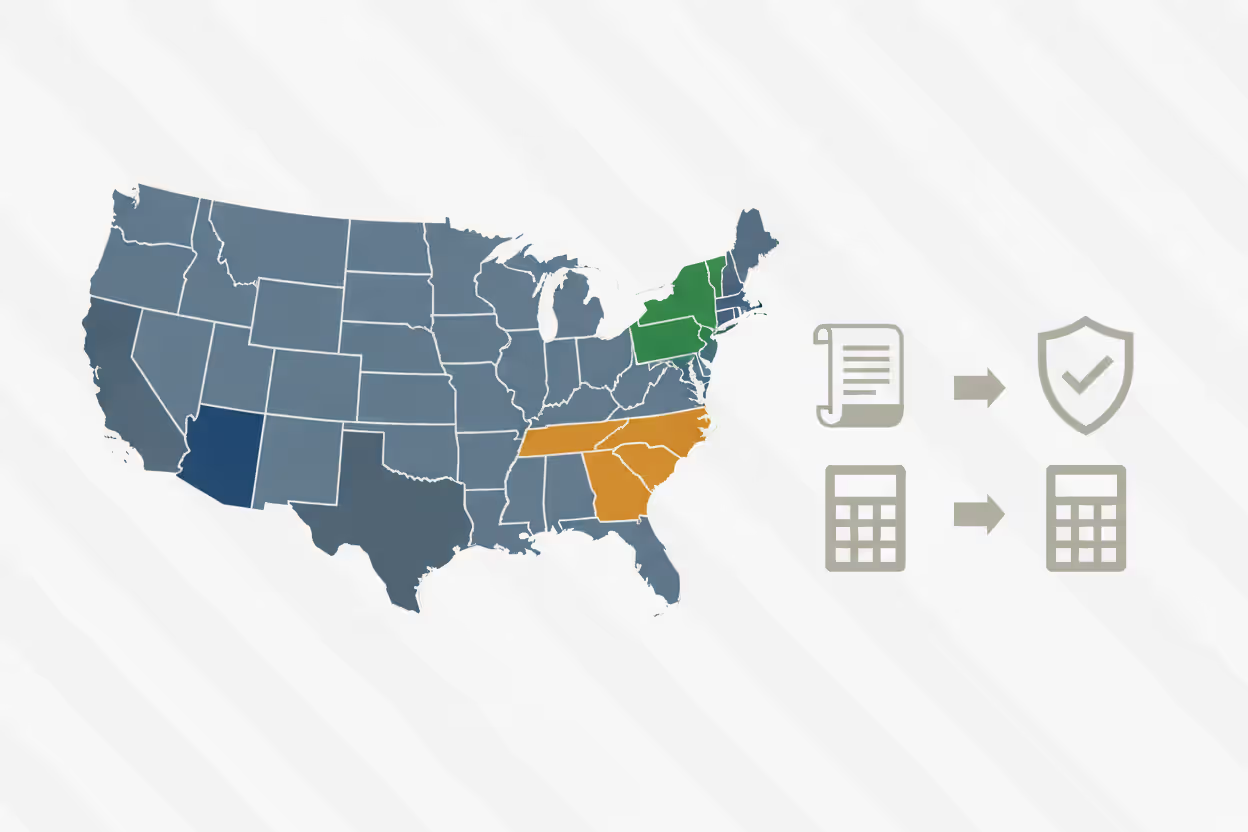
Three states dominate the "business-friendly formation" conversation: Delaware, Wyoming, and Nevada. Each offers legitimate advantages—for specific situations that probably don't match your circumstances.
Understanding what state to form llc in requires separating marketing hype from practical benefits.
Author: Kevin Halbrook;
Source: worldwidemediums.net
Delaware LLC Benefits and Drawbacks
Delaware built an entire industry around business formations. The Court of Chancery—a specialized court handling only business cases, with judges instead of juries—has generated over 200 years of case law. That predictability matters tremendously if you're structuring complex investor agreements or planning an IPO.
Delaware's other advantages: strong liability shields, flexible operating agreement provisions, and member names don't appear in public filings (offering privacy). Single-member LLCs are allowed. The legal infrastructure handles sophisticated business transactions smoothly.
The costs, though: $90 to form, $300 annually in franchise tax, plus you'll need a Delaware registered agent ($50-$125 yearly). If you're doing business in another state—say you're actually operating in New Jersey—add New Jersey's fees on top. You're now maintaining registrations in two states.
Delaware makes sense for venture-backed startups, companies raising significant capital, businesses with complex ownership structures, or companies planning acquisition or going public. For a single-member LLC running a consulting practice or local service business? Delaware adds expense without benefit.
Wyoming LLC Benefits and Drawbacks
Wyoming aggressively courts LLC formations with low costs and privacy features. Formation runs $100, annual reports cost $60. The state has no corporate income tax and no franchise tax on LLCs.
Privacy is Wyoming's signature offering. Member names don't appear in formation documents. Nominee services can further obscure ownership (though federal beneficial ownership reporting to FinCEN now requires disclosure anyway).
The real drawback is limited case law. Delaware has centuries of business court precedents. Wyoming doesn't. If you face a complex legal dispute, there's less guidance on how Wyoming courts will rule. That uncertainty can complicate litigation.
Wyoming works well for specific use cases: holding companies owning real estate or intellectual property, fully online businesses with no physical nexus elsewhere, or asset protection structures designed with legal counsel. It's poorly suited if you'll trigger foreign qualification in a high-tax state.
Nevada LLC Benefits and Drawbacks
Nevada offers no corporate income tax, no franchise tax, and no information-sharing agreement with the IRS. The state provides strong charging order protections—if someone sues you personally and wins, they can't easily seize your LLC membership interest or force distributions.
Privacy features include not requiring member names in public filings (similar to Wyoming and Delaware). Nevada allows significant ownership flexibility.
The costs are higher, though. Online filing costs $75 (paper filing is $425), but Nevada also requires a business license starting at $500 annually. That license fee increases with gross revenue. A business earning over $4 million annually pays thousands in license fees.
Nevada attracts asset protection-focused businesses, particularly those holding valuable intellectual property or investment portfolios. The charging order protections matter most to high-net-worth individuals concerned about personal creditors.
Foreign LLC Registration: What It Means and What It Costs
"Foreign LLC" confuses people because it sounds international. It's not. Foreign just means "from another state."
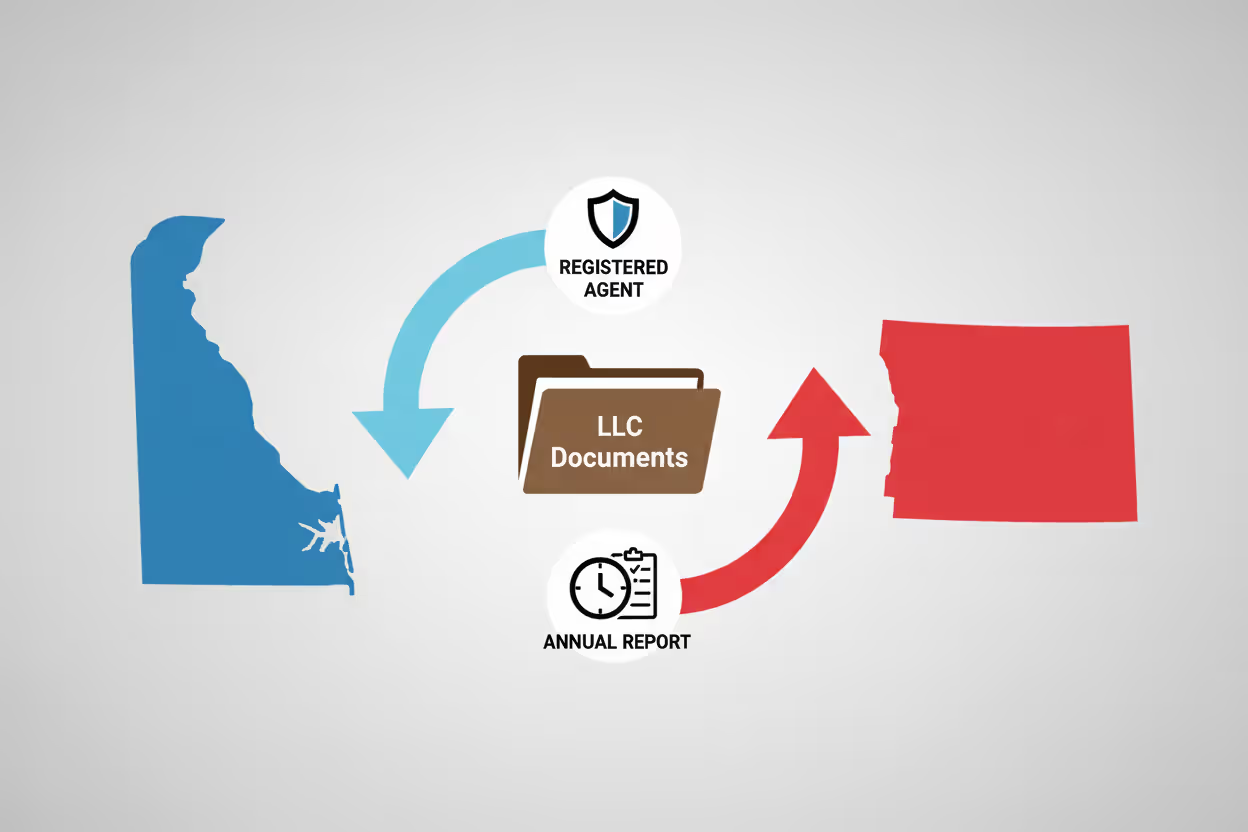
You register as a foreign LLC when you form in one state but operate in another. This is called foreign qualification.
What triggers the requirement? Each state defines "doing business" slightly differently, but these activities almost always require registration:
- Maintaining a physical office, retail location, or warehouse
- Having employees working in the state
- Storing inventory you intend to sell
- Owning or leasing real property
- Meeting regularly with clients at a location you control
What typically doesn't trigger it: shipping products to customers, attending occasional conferences, making sales calls, or having an independent contractor work there temporarily.
The costs compound quickly. Initial foreign registration runs $100-$300 in most states. Registered agents in each state cost $50-$150 annually. Annual reports are required in your formation state and every foreign qualification state—each with separate fees and deadlines.
California demonstrates the trap perfectly. The state imposes an $800 minimum franchise tax on every LLC "doing business" there, regardless of formation state. Form your LLC in Wyoming ($60/year) but operate in California? You're paying Wyoming's $60 plus California's $800 plus registered agent fees in both states. That's over $1,000 annually—more than just forming in California originally.
Which state should i form my llc in often reduces to simple math: do the benefits of State A outweigh the costs of also registering in State B where you actually operate?
Author: Kevin Halbrook;
Source: worldwidemediums.net
Key Factors to Compare When Choosing Your LLC State
Look beyond the marketing headlines to factors that affect your daily operations and annual costs.
How the state taxes LLCs: Most states treat LLCs as pass-through entities—the LLC doesn't pay entity-level tax; profits pass to members' personal returns. But some states add entity-level charges. Texas imposes a franchise tax on LLCs with revenue exceeding $1.23 million. California hits almost every LLC with its $800 minimum franchise tax, regardless of whether you turned a profit.
Ongoing costs, not just formation fees: That $100 formation fee is a one-time expense. Annual requirements last forever. Calculate total annual costs: registered agent fees + annual report charges + franchise taxes + business license fees. A state with a $300 formation fee but $50 annual costs beats a state with a $100 formation fee but $500 annual costs—after just two years.
Privacy protections (which matter less than you think): Wyoming, Nevada, Delaware, and New Mexico don't require member names in formation documents. But federal beneficial ownership reporting (effective 2024) requires you to report ownership to FinCEN regardless of state privacy laws. State privacy now protects mainly against casual database searches, not serious investigation.
Asset protection strength: States vary significantly on charging order protections. When a creditor wins a judgment against you personally (not your LLC), can they seize your membership interest or only wait for distributions? Wyoming and Delaware offer strong protections. Some states give single-member LLCs weaker protection than multi-member LLCs.
Administrative ease: Can you file formation documents online and get approval in 24 hours, or must you mail paper forms and wait three weeks? Simple processes reduce errors and frustration. Check how easily you can file amendments, annual reports, and eventually dissolution paperwork.
Industry-specific rules: Some industries face state-level restrictions that override general formation advantages. Professional LLCs (doctors, lawyers, accountants, architects) typically must form in the state where they're licensed to practice. Cannabis businesses must form where they operate due to federal interstate commerce restrictions. Financial services companies face registration requirements in every state where they have clients.
Common Mistakes When Selecting an LLC Formation State
The biggest misconception I encounter is business owners forming their LLC in Wyoming or Nevada to 'save on taxes,' without understanding they still owe taxes in their home state where they actually run the business. They pay fees in two states and double their compliance work, all while getting zero tax benefit. For 90% of small businesses I work with, their home state is the obvious right answer
— Jennifer Martinez
State-by-State
Falling for the hype: Wyoming and Delaware spend heavily marketing their business advantages. That marketing works—people form there without calculating foreign qualification costs. You end up paying fees in two states when one would've sufficed.
Forgetting to add up foreign qualification: The calculation isn't "Wyoming costs $60 annually versus California's $800." It's "Wyoming costs $60 + California foreign qualification costs $800 + registered agents in both states cost $200 = $1,060 total" versus "California only costs $800." Suddenly California is $260 cheaper.
Thinking you can avoid home state taxes: You can't. If you live in Massachusetts, work from a home office in Massachusetts, and serve primarily Massachusetts clients, you have nexus in Massachusetts. Forming in Nevada doesn't eliminate Massachusetts tax obligations—it just adds Nevada fees on top of Massachusetts requirements.
Focusing on formation costs instead of lifetime costs: A $50 difference in filing fees is irrelevant compared to annual costs over 10-20 years. A state charging $200 to form but $100 annually costs $1,200 over ten years. A state charging $100 to form but $300 annually costs $3,100 over the same period.
Underestimating administrative hassle: Tracking multiple state deadlines, filing different forms, potentially hiring service providers in multiple states—this takes time. For solo entrepreneurs or small teams, administrative overhead diverts attention from actually building the business.
Applying startup advice to non-startup businesses: What works for venture-backed tech companies doesn't work for local service providers. Delaware's Court of Chancery offers zero value to a single-member LLC providing landscaping services, but articles about "best states for LLCs" rarely make that distinction.

Author: Kevin Halbrook;
Source: worldwidemediums.net
LLC Formation Cost and Requirements Comparison
| State | Formation Fee | Annual Fees/Taxes | Registered Agent | Privacy Level | Tax Structure |
| Delaware | $90 | $300 franchise tax | Required | Moderate – member names not listed publicly | No state income tax on out-of-state earnings |
| Wyoming | $100 | $60 for annual report | Required | Strong – members not disclosed in filings | No corporate or personal income tax |
| Nevada | $75 online / $425 by mail | $500+ business license | Required | Strong – member names not published | No corporate income tax |
| California | $70 | $800 minimum franchise tax | Required | Low – requires member disclosure | Pass-through taxation, 8.84% corporate rate |
| Texas | $300 | None unless revenue exceeds $1.23M | Required | Moderate | No personal income tax; franchise tax on high revenue |
| New York | $200 | $9 every two years | Required | Low – member names required | Pass-through structure, progressive state income tax |
| Florida | $125 | $138.75 annual report fee | Required | Moderate | No state personal income tax |
Frequently Asked Questions About LLC State Selection
Start with physical reality. Where will you have a lease, employees, or inventory? If the answer is one state, that's almost certainly your formation state.
Calculate real total costs. Add formation fees + five years of annual reports + franchise taxes + registered agent fees for every state where you'd need registration. Compare the totals. The differences might surprise you.
Consider where you're headed. Launching a tech startup seeking venture funding? Delaware's legal infrastructure might justify the cost. Starting a local service business? Your home state makes sense even if you eventually expand regionally.
Check industry-specific restrictions. Professional services, financial businesses, and licensed industries often face regulations that override general formation considerations.
Talk to professionals who know your situation specifically. A CPA familiar with your state's tax structure can calculate the real financial impact. An attorney can assess whether specialized legal protections matter for your business model and personal asset protection needs.
The best state for llc formation varies by business. It depends on where you operate, how you're structured, what you're building, and whether any particular state's features justify the added costs and complexity.
For most small businesses, the answer is straightforward: form your LLC where you conduct business. The exceptions—venture-backed startups, holding companies, genuinely multi-state operations, or specialized asset protection structures—are real but uncommon. Don't let generic online advice or marketing hype push you into unnecessary complexity when the simple path serves you better. Sometimes boring is best.
Related Stories

Read more

Read more




The content on this website is provided for general informational and educational purposes only. It is intended to explain concepts related to Limited Liability Companies (LLCs), including formation, management, taxation, compliance, and business structuring.
All information on this website, including articles, guides, templates, and examples, is presented for general educational purposes. LLC requirements and regulations may vary depending on individual circumstances, business activities, state laws, and jurisdiction.
This website does not provide legal, tax, or financial advice, and the information presented should not be used as a substitute for consultation with qualified legal, tax, or financial professionals.
The website and its authors are not responsible for any errors or omissions, or for any outcomes resulting from decisions made based on the information provided on this website.