

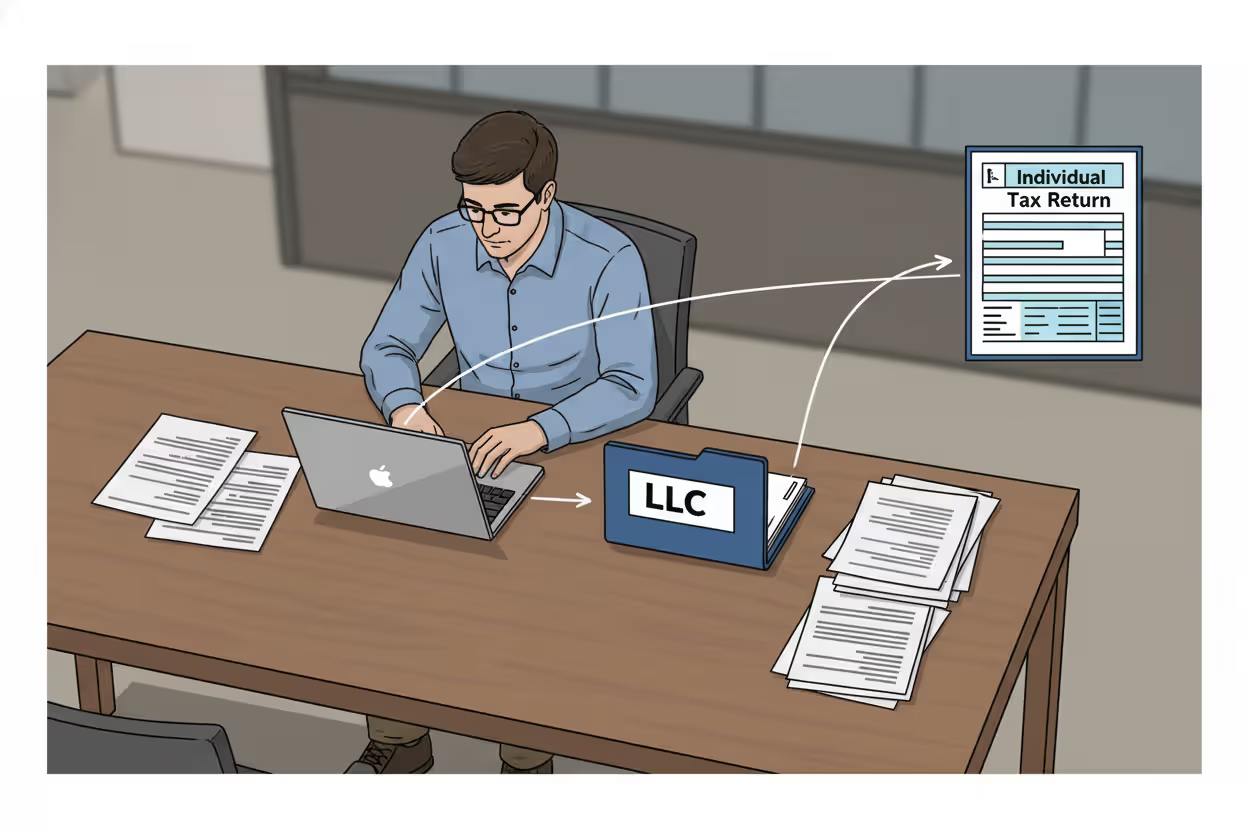
Small business owner reviewing LLC tax documents at office desk
How to File Business Taxes for LLC?

Tax season transforms many LLC owners into nervous wrecks, but the process becomes straightforward once you crack the code. Your filing requirements depend entirely on how the IRS classifies your business structure—not what you call yourself. A one-person consulting firm faces completely different obligations than a three-partner real estate investment group, even though both are technically LLCs.
Here's the twist that confuses everyone: the IRS doesn't actually have a tax category called "LLC." Your limited liability company exists for legal purposes, but when April rolls around, the tax agency treats you as something else entirely. Understanding this fundamental disconnect is your first step toward filing correctly and avoiding penalties that can run into thousands of dollars.
Understanding LLC Tax Classifications
Think of your LLC as a chameleon for tax purposes. The entity adapts to one of four different identities: sole proprietorship, partnership, S corporation, or C corporation. Each classification triggers distinct filing requirements, deadlines, and tax bills.
When you form a single-member LLC and take no further action, the IRS automatically treats you as a sole proprietorship. They use the term "disregarded entity," which sounds insulting but simply means your business profits flow straight through to your personal Form 1040. You'll complete Schedule C showing your revenue and expenses, calculating net income that gets taxed at your individual rate.
Multi-member LLCs receive automatic partnership classification unless you file paperwork requesting different treatment. The partnership itself doesn't write a check to the IRS for income taxes. Instead, it files an informational return showing how profits get split among members. Each person then pays tax on their share, even if the cash stays in the business—a reality that surprises many first-time LLC partners.
You're not stuck with default classifications. Filing Form 2553 converts your LLC into an S corporation for tax purposes. This election makes sense when your profits hit certain thresholds because it can slash self-employment taxes. Instead of paying 15.3% on all net earnings, you can pay yourself a reasonable salary (subject to payroll taxes) and take additional profits as distributions (which avoid the self-employment tax bite).
Let's say your LLC generates $150,000 in net profit. As a default sole proprietorship, you'd pay roughly $22,950 in self-employment tax alone. Elect S corp status, pay yourself a $70,000 salary, and take $80,000 as distributions? Your self-employment tax drops to around $10,710—saving over $12,000. The catch is that S corporations require payroll processing, quarterly filings, and stricter compliance. The numbers need to justify the extra administrative burden.
Form 8832 allows C corporation election, though this rarely benefits small LLCs. C corps face double taxation—the corporation pays tax on profits, then shareholders pay again on dividends. The flat 21% corporate rate appeals to businesses reinvesting most earnings or pursuing venture capital, but most service-based LLCs find this structure too expensive.
Author: Samantha Rowe;
Source: worldwidemediums.net
Partnership classification divides income according to your operating agreement percentages. If you own 60% and your partner owns 40%, that's generally how profits get allocated—though you can structure guaranteed payments or special allocations for specific situations. The partnership prepares Schedule K-1 forms showing each member's income share. These K-1s then get reported on personal tax returns, where members pay at their individual rates.
Required Tax Forms by LLC Type
Your tax classification determines which forms you'll complete. Here's how different structures correspond to specific IRS paperwork:
| LLC Classification | IRS Form(s) Required | Filing Deadline | Who Must File |
| Sole Proprietorship (single-member) | Schedule C attached to Form 1040 | April 15 | Single-owner LLCs using default classification |
| Partnership (multi-member) | Form 1065 with Schedule K-1s for each partner | March 15 | Two or more members under default treatment |
| S Corporation | Form 1120-S with Schedule K-1s for shareholders | March 15 | Any LLC that submitted Form 2553 election |
| C Corporation | Form 1120 | April 15 | LLCs that filed Form 8832 choosing corporate taxation |
Sole proprietorship taxation also requires Schedule SE, which calculates your self-employment tax obligation. This covers Social Security and Medicare contributions that employers would normally withhold. For 2026, the calculation applies 15.3% to the first $168,600 of net earnings. Above that threshold, you'll still owe 2.9% for Medicare, plus an additional 0.9% if your income exceeds $200,000 (or $250,000 married filing jointly).
Multi-member LLCs filing partnership returns must distribute Schedule K-1 to every partner by the March 15 deadline. This informational return shows revenue, expenses, and profit allocation without the partnership paying federal income tax directly. If your partnership includes foreign partners, you'll tackle additional reporting requirements including Form 8805 and potential withholding obligations that complicate matters significantly.
S corporations follow similar K-1 distribution requirements but face the added responsibility of running payroll for owner-employees. You'll file quarterly Form 941 to report employment taxes and issue annual Form W-2s showing wages paid. The IRS watches carefully for unreasonably low salaries—you can't simply pay yourself $20,000 and take $180,000 as distributions to dodge payroll taxes. Your salary should reflect market rates for someone performing your job functions.
C corporations tackle the most complex return structure. Form 1120 demands detailed schedules covering balance sheets, income reconciliation, and retained earnings analysis. Unless you have compelling strategic reasons—like attracting investors who prefer corporate structures—most single-member LLCs steer clear of this classification.
State requirements create an additional filing layer that varies dramatically by location. California imposes an $800 annual franchise tax on all LLCs regardless of profit or loss, due even during your first year of operation. Delaware requires annual reports plus a $300 tax. New York adds filing fees and county-specific publication requirements that can exceed $1,500 in certain jurisdictions.

Author: Samantha Rowe;
Source: worldwidemediums.net
Step-by-Step LLC Tax Filing Process
Successful LLC tax filing starts months before deadline pressure hits. The process encompasses year-round organization, estimated payments, careful form completion, and both federal and state submissions.
Organizing Financial Records and Documentation
Keep business and personal money in separate universes. Open a dedicated business checking account under your LLC's legal name and route every business transaction through it exclusively. When you mix personal and business funds, tax preparation becomes archaeological excavation work—and you risk losing deductions because you can't prove business purpose.
Documentation drives deductions. The IRS can reject expenses if you lack proof they occurred. Save every receipt, and for meals or entertainment, write down who attended and what business you discussed right on the receipt itself. Vehicle deductions require a mileage log created as you drive, not retroactively reconstructed in March when panic sets in. Note the date, destination, miles traveled, and business purpose for each trip.
Categorize transactions as they happen rather than facing a shoebox full of receipts in April. Build categories matching IRS expense classifications: advertising costs, vehicle expenses, insurance premiums, legal and professional fees, office supplies, rent payments, equipment purchases, travel expenses, and utilities. This organization makes form completion mechanical instead of stressful while highlighting deductible expenses you might otherwise overlook.
Multi-member LLCs need tracking systems showing each member's capital contributions, cash distributions, and guaranteed payments throughout the year. Your operating agreement establishes profit-sharing percentages, but actual cash movements often tell a different story. Precise records prevent partner disputes and ensure Schedule K-1 forms accurately reflect each member's tax situation.

Author: Samantha Rowe;
Source: worldwidemediums.net
Completing Your Federal Tax Return
Begin by totaling gross receipts from all sources—sales revenue, service fees, investment income, and any other money flowing into your business. Cash-basis taxpayers (the majority of small LLCs) record income when payment hits your account, not when you send an invoice. Accrual-basis taxpayers recognize income when earned, regardless of when payment arrives.
Product-based businesses deduct cost of goods sold before calculating gross profit. This category includes inventory purchases, storage expenses, and direct labor costs for production. Service businesses typically skip this section and move straight to gross profit calculations.
Business expense deductions come next—anything ordinary and necessary for your industry qualifies. "Ordinary" describes expenses common among businesses like yours. "Necessary" covers items helpful and appropriate for operations, even if not absolutely essential. Software subscriptions, professional development courses, marketing campaigns, equipment purchases, and dozens of other categories qualify for deduction.
Home office deductions require a specific space used exclusively and regularly for business activities. Your dining room table doesn't qualify if you also eat meals there. Calculate the square footage of your dedicated office space as a percentage of your home's total area. That percentage applies to mortgage interest, property taxes, utilities, insurance, and maintenance costs. Alternatively, use the simplified calculation allowing $5 per square foot for up to 300 square feet.
Calculate self-employment tax using Schedule SE based on your net profit figure. The 15.3% rate hits hard, but you can deduct half of this amount on your Form 1040, which somewhat reduces the pain. S corporation shareholders avoid self-employment tax on distributions but must pay standard employment taxes on salary portions.
Partnership and S corporation returns demand additional schedules tracking capital accounts, member basis calculations, and distribution details. Form 1065 includes Schedule M-1 reconciling the difference between your bookkeeping records and tax-reported income, catching timing differences and permanent variances between accounting methods.
State Tax Filing Requirements
State tax obligations vary wildly across the country. Nine states—Alaska, Florida, Nevada, New Hampshire, South Dakota, Tennessee, Texas, Washington, and Wyoming—skip personal income taxes, though several still impose business-specific taxes or mandatory annual fees.
States with income tax systems generally mirror federal classification. Disregarded entities federally usually receive the same treatment at state level. But exceptions create traps. California taxes LLCs based on gross receipts regardless of profit, with annual fees ranging from $800 to $11,790. New York demands partnership returns even from single-member LLCs in specific circumstances.
Operating across state lines creates nexus complications. Physical presence, employees, or significant sales volume in multiple states can trigger filing requirements in each jurisdiction. Economic nexus rules following the Wayfair decision mean remote sellers can owe taxes based solely on sales thresholds—typically $100,000 in revenue or 200 transactions within a state.
Several states require quarterly estimated payments mirroring federal schedules. Others impose annual franchise taxes calculated on net worth or authorized capital. Research your specific state's requirements thoroughly or work with a CPA experienced in multi-state tax compliance.
LLC Tax Deductions and Write-Offs
Strategic deduction planning legally reduces your tax burden. Common write-offs available to LLCs include:
Vehicle expenses: Choose between tracking actual costs (fuel, insurance, repairs, depreciation) or applying the standard mileage rate (67 cents per mile for 2026). You can't alternate between methods during the year, and once you depreciate a vehicle using actual expenses, you're committed to that method for the vehicle's life in your business.
Home office deduction: Measure your dedicated office space and calculate it as a percentage of total home square footage. A 200-square-foot office in a 2,000-square-foot house means you can deduct 10% of mortgage interest, property taxes, utilities, and maintenance. The simplified method offers $5 per square foot up to 300 square feet total ($1,500 maximum deduction).
Equipment and technology purchases: Section 179 allows immediate expensing of up to $1,220,000 in equipment purchases during 2026 rather than depreciating assets over multiple years. Computers, software, office furniture, and machinery all qualify. Bonus depreciation provides a 60% first-year deduction on many additional assets.
Professional services: Deduct the full cost of legal fees, accounting expenses, business consulting, and professional development. Educational courses, industry conferences, and relevant certifications that improve skills for your current business all qualify for deduction.
Marketing and advertising investments: Website hosting, social media advertising, business cards, promotional materials, and event sponsorships count as deductible marketing expenses. Track campaign results carefully to distinguish legitimate business promotion from personal activities that happen to mention your company.
Self-employment tax deserves strategic attention. While sole proprietors and partners can't eliminate it, you can reduce the burden through smart planning. Electing S corporation status splits income between salary (subject to payroll taxes) and distributions (exempt from self-employment tax). The IRS scrutinizes unreasonably low salaries, so target compensation comparable to market rates for someone performing your role.
Estimated quarterly payments prevent underpayment penalties and interest charges. If you'll owe $1,000 or more after subtracting withholding and credits, quarterly payments become mandatory. Calculate 90% of your current year tax liability or 100% of last year's tax (110% if prior adjusted gross income exceeded $150,000), whichever provides the smaller required payment. Deadlines fall on April 15, June 15, September 15, and January 15 of the following year.

Author: Samantha Rowe;
Source: worldwidemediums.net
Filing Deadlines and Extensions
Missing deadlines costs real money. The IRS assesses failure-to-file penalties at 5% monthly (capped at 25% total) plus interest on unpaid balances. Failure-to-pay penalties add another 0.5% per month. A $10,000 unpaid tax bill filed six months late generates roughly $3,000 in penalties before interest calculations even begin.
Sole proprietorship LLCs follow individual taxpayer deadlines: April 15 for most filers. Partnerships and S corporations face March 15 deadlines, giving members and shareholders time to receive their Schedule K-1 forms before personal returns come due.
Extensions buy additional time but don't postpone payment obligations. Form 7004 grants partnerships and corporations an automatic six-month extension. Individual taxpayers file Form 4868 for equivalent relief. You must still estimate and pay taxes owed by the original deadline to avoid penalties and interest.
Quarterly estimated payment schedule follows this specific calendar: - Q1 (January 1–March 31): Payment due April 15 - Q2 (April 1–May 31): Payment due June 15
- Q3 (June 1–August 31): Payment due September 15 - Q4 (September 1–December 31): Payment due January 15 of following year
Notice the quirky quarter lengths—Q2 covers only two months while Q4 spans four. The IRS operates on its own timeline logic.
State deadlines frequently match federal dates but not universally. Some states demand estimated payments when federal rules wouldn't require them. Maintain separate calendars for federal and state obligations to prevent missed deadlines and resulting penalties.
Common LLC Tax Filing Mistakes to Avoid
Mixing personal and business funds: Running personal expenses through your business account or business costs through personal accounts destroys your LLC's liability protection and creates tax nightmares. The IRS may disallow deductions when they can't distinguish business purposes from personal spending.
Skipping estimated payments: Waiting until April to pay your entire tax bill triggers underpayment penalties regardless of whether you have the cash. The IRS operates on a pay-as-you-earn system. Calculate quarterly obligations based on projected annual income and pay throughout the year.
Choosing the wrong classification: Electing S corporation status without establishing payroll systems, or remaining a sole proprietorship when S corp treatment would save thousands annually, both drain your finances unnecessarily. Review your tax classification every year as revenue and profit levels change.
Ignoring state-specific requirements: Hyperfocusing on federal returns while overlooking state franchise taxes, annual report filings, or local business license renewals creates compliance gaps. Several states assess penalties even when you owe zero tax, simply for missing filing deadlines.
Inadequate record-keeping systems: Reconstructing expenses from memory months later or working with incomplete documentation leads to missed deductions and elevated audit risk. Implement organizational systems on day one, not when tax deadlines approach.
Claiming inappropriate deductions: Personal meals, daily commuting mileage, everyday clothing that could be worn outside work, and fines or penalties aren't deductible business expenses. Taking aggressive positions on questionable expenses invites IRS audits.
Failing to track basis: S corporation shareholders and partnership members must track their basis—essentially their investment in the company plus allocated income minus distributions and losses. You can't deduct losses exceeding your basis, and distributions above basis create taxable income.

Author: Samantha Rowe;
Source: worldwidemediums.net
When to Hire a Tax Professional
DIY tax filing works adequately for uncomplicated single-member LLCs with straightforward income and basic expense categories. Software like TurboTax handles Schedule C reasonably well if you understand the questions being asked and your situation lacks complexity.
Professional help becomes valuable when:
You're managing multiple members: Partnership taxation involves intricate allocation rules, basis tracking, and potential guaranteed payment structures. Mistakes create disputes among partners and increase IRS scrutiny.
You're evaluating entity election options: Choosing among sole proprietorship, partnership, S corporation, or C corporation status creates multi-year tax implications. CPAs can model different scenarios showing tax impacts under each structure to inform your decision.
You're operating across state lines: Nexus rules, income apportionment formulas, and varying state requirements make multi-state taxation genuinely complicated. Professionals familiar with your specific states prevent expensive errors and missed filing requirements.
Your revenue crosses $250,000: Higher income means larger tax obligations and increased audit probability. Professional preparation frequently pays for itself through legitimate deductions you'd miss and provides audit support if the IRS comes calling.
You're claiming complex deductions: Home office calculations, vehicle depreciation schedules, cost segregation studies for real estate, and research and development credits benefit from expert knowledge. The tax code offers dozens of strategies most business owners never discover.
CPA fees range from $500 to $3,000 or more depending on complexity. Partnership and S corporation returns cost more than simple Schedule C filings. Multi-state returns, complicated ownership structures, and high transaction volumes push fees higher. Request pricing information upfront and clarify what services the fee includes.
Enrolled agents specialize exclusively in taxation and typically charge less than CPAs while providing similar expertise for straightforward returns. Tax attorneys handle complex situations involving IRS disputes, international transactions, or sophisticated entity structuring decisions.
The biggest mistake new LLC owners make is assuming they don't need to file taxes because the LLC didn't make a profit. The IRS still requires informational returns, and missing deadlines can result in significant penalties
— Robert Chen
Frequently Asked Questions About LLC Tax Filing
Filing business taxes for your LLC becomes manageable once you understand your tax classification and the forms it requires. Single-owner LLCs generally file Schedule C with their personal tax returns, while multi-member LLCs submit partnership returns with K-1s distributed to each owner. S corporation and C corporation elections add complexity but can deliver tax advantages when your revenue reaches certain levels.
Success depends on maintaining organized records year-round rather than scrambling during April. Keep business and personal finances completely separate, categorize expenses as they occur, and submit quarterly estimated payments to avoid penalties. Know your specific deadlines—March 15 for partnerships and S corporations, April 15 for sole proprietorships and C corporations—and request extensions when necessary, though remember payment obligations don't extend.
Don't let classification uncertainty prevent you from filing. Most new LLCs begin with default treatment as sole proprietorships or partnerships, then elect S corporation status later when the mathematics justify additional compliance requirements. Evaluate your situation annually as your business grows and revenue increases.
When complexity exceeds your comfort zone—multiple members, multi-state operations, substantial income—hiring a CPA or enrolled agent frequently saves more money than it costs through legitimate deductions found and mistakes prevented. The tax code provides numerous strategies for reducing LLC tax burdens, but you need awareness to claim them.
File by your deadline, pay what you owe, and maintain documentation for at least three years (six years if you underreport income by 25% or more). The IRS shows patience about many things, but missing deadlines and underpaying taxes aren't among them.
Related Stories

Read more

Read more



The content on this website is provided for general informational and educational purposes only. It is intended to explain concepts related to Limited Liability Companies (LLCs), including formation, management, taxation, compliance, and business structuring.
All information on this website, including articles, guides, templates, and examples, is presented for general educational purposes. LLC requirements and regulations may vary depending on individual circumstances, business activities, state laws, and jurisdiction.
This website does not provide legal, tax, or financial advice, and the information presented should not be used as a substitute for consultation with qualified legal, tax, or financial professionals.
The website and its authors are not responsible for any errors or omissions, or for any outcomes resulting from decisions made based on the information provided on this website.