

Small business tax paperwork on desk with laptop and documents
When Do LLC Taxes Need to Be Filed?

The IRS doesn't send calendar invites for tax deadlines. You'll get no text reminder, no friendly email, no grace period notification. The first signal you've missed your filing date usually arrives as a penalty notice calculating fees you didn't budget for.
Your LLC's tax situation exists in a strange paradox: the business structure protecting your personal assets from lawsuits becomes legally invisible when April rolls around—or March, depending on choices you've made. The federal government recognizes your company for everything except taxation, then asks you to pick which tax category fits your situation.
Picture an office building where three LLC owners work side by side. The solo graphic designer submits paperwork in mid-April. The husband-wife consulting team who added a business partner last January? Their deadline hit four weeks earlier in March. The software developer who switched to S corp treatment? Same March cutoff, but she's also running payroll and filing quarterly employment forms the other two never touch. Three people, identical business structures on paper, completely different tax calendars.
Tax filing represents just one piece of a larger compliance puzzle. You're juggling quarterly payment schedules that don't align with your annual deadline, state requirements operating on completely separate timelines, and extension rules that let you delay paperwork while demanding immediate payment. Here's exactly when your returns come due based on how you've structured tax treatment.
How LLCs Are Taxed by the IRS
Federal tax law treats your LLC like a legal ghost. You filed formation documents with your state, paid registration fees, and established liability protection separating business debts from personal assets. The IRS acknowledges this protection exists, then essentially asks: "For taxation purposes, what type of business are you pretending to be?"

Author: Samantha Rowe;
Source: worldwidemediums.net
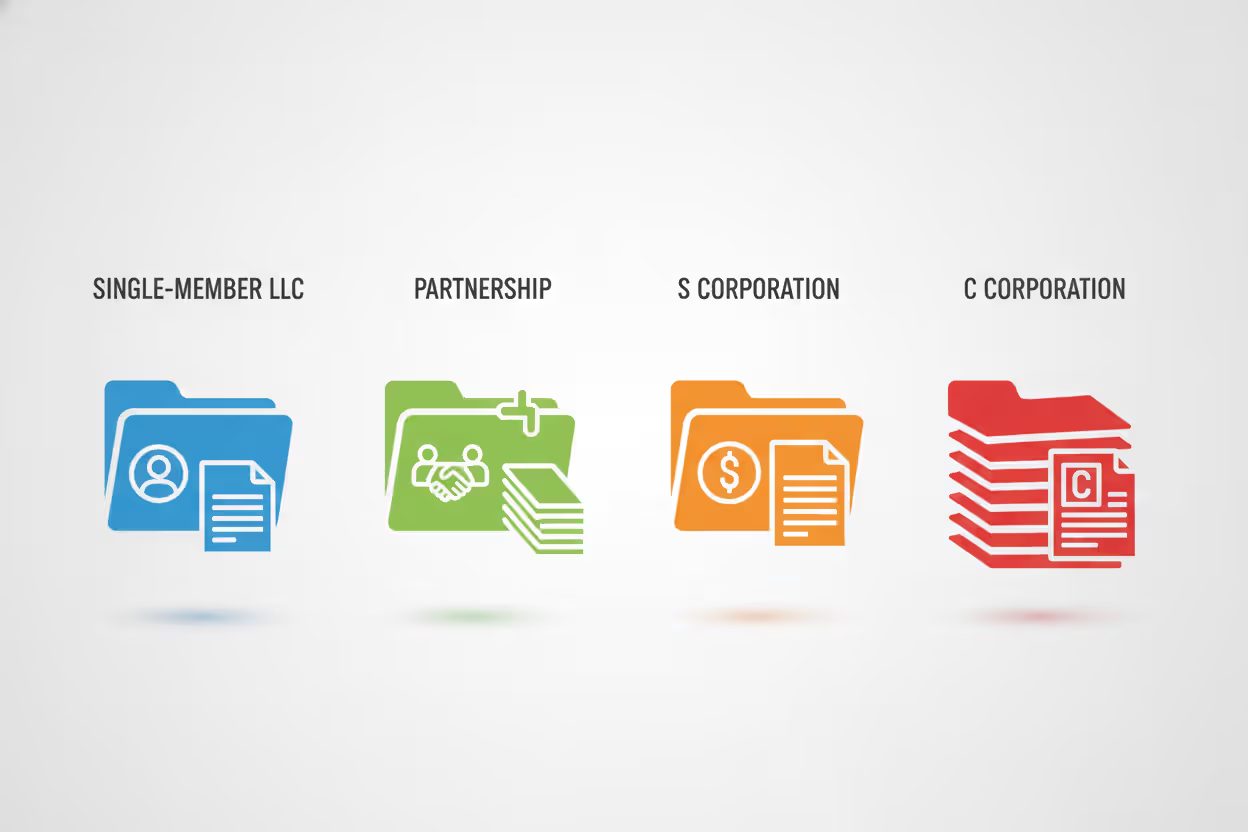
You get to choose. Tax lawyers call these "check-the-box regulations"—you're selecting from a menu of tax personalities:
Running solo without filing special forms? You're automatically categorized as a sole proprietorship for tax purposes. Your LLC becomes what the IRS calls a "disregarded entity." Business income reports directly on your personal Form 1040 using Schedule C, as though the company structure never existed.
Bringing in a second owner fundamentally changes your default category. The moment you add a partner, you're automatically treated as a partnership for federal filing purposes.
Nothing about these defaults is permanent. Submit Form 2553 and you're requesting S corporation treatment. Form 8832 switches you to C corporation status. Either election completely reorganizes your tax calendar and changes which forms you'll spend April preparing.
The distinction between pass-through and corporate taxation matters tremendously here. Pass-through structures—covering sole proprietorships, partnerships, and S corporations—mean your LLC doesn't directly pay federal income tax. Business profit flows through to individual returns. The company submits informational documents showing how profit split among owners, but actual tax liability lands on personal filings.
C corporations work differently. The business entity pays its own federal tax at a flat 21% rate on earnings. When you take those profits out as dividends, you're paying personal income tax on the same money again. Tax accountants call this "double taxation," explaining why most small business owners avoid C corp status unless specific circumstances make it worthwhile.
When do LLC file taxes? Your answer depends entirely on which of these four tax categories you've selected. The IRS schedules deadlines based on your tax structure, not your state formation paperwork.
Author: Samantha Rowe;
Source: worldwidemediums.net
Tax Filing Deadlines by LLC Type
Single-Member LLC Tax Deadline
Business activity flows onto Schedule C, which attaches to Form 1040—your standard personal income tax filing. The single-member LLC tax deadline mirrors the individual tax calendar: April 15 (or the next business day when April 15 falls on Saturday, Sunday, or a holiday).
No separate business return exists. Revenue, expenses, and net profit all fold into your personal 1040. This creates simplicity in one sense—fewer forms to track. But it also creates a constraint: you can't separate business filing from personal taxes. Waiting for personal tax documents means your business reporting also waits.
Running behind schedule? Form 4868 extends your deadline to October 15. Estimate what you'll owe, submit the form by April 15, and you'll receive automatic approval without waiting for IRS review. Here's where people make expensive mistakes: extensions cover filing paperwork, not paying taxes. Any liability you estimate needs payment by April 15, or interest starts accumulating that exact day.
A landscaping contractor I worked with learned this the expensive way. He requested an extension thinking it covered everything, then filed in October owing $8,000. Six months of interest plus penalties added nearly $600 to his bill—money he'd never anticipated spending.
Another misconception I hear constantly: "My LLC barely made money, so I don't need to file." Wrong. Schedule C filing is mandatory regardless of profit levels. Operating at a loss might actually lower your total tax burden, potentially generating a refund. Skipping the filing triggers penalties while you forfeit potential tax benefits.
Multi-Member LLC (Partnership) Deadline
Adding even one partner changes everything about your filing calendar. Form 1065 comes due March 15—a full month before individual returns. This partnership return doesn't actually pay taxes. It's informational, reporting total income and expenses plus how profits divided among partners.
The earlier March cutoff serves a strategic purpose. Each partner receives a Schedule K-1 showing their share of partnership income, losses, deductions, and credits. They need time to incorporate K-1 information into personal returns due April 15. If both deadlines hit simultaneously, partners would receive critical tax documents on the same day they need to file—creating an impossible situation.
Form 1065 carries particularly brutal penalties. The IRS charges $245 per partner for each month (or partial month) you're late, continuing up to 12 months maximum. Two partners filing three months behind schedule pay $1,470 in penalties ($245 × 2 partners × 3 months). These charges apply whether your partnership was wildly profitable, barely broke even, or operated at a loss. The return must be submitted regardless of money owed, or penalties accumulate on autopilot.

Author: Samantha Rowe;
Source: worldwidemediums.net
I've watched a three-partner LLC pay $8,820 in penalties for submitting a year late despite losing money that year. The IRS assesses informational return penalties without considering profitability.
LLC Taxed as S Corporation Deadline
Filing Form 2553 to elect S corporation status commits you to Form 1120-S. Your LLC filing due date becomes March 15, matching the partnership calendar.
S corporations also issue K-1s to shareholders (your LLC members become shareholders under S corp treatment). The March deadline ensures shareholders get their K-1 information before personal returns come due the following month.
S corporation treatment adds real complexity: you must pay yourself reasonable wages for work you actually perform in the business. "Reasonable" lacks precise IRS definition, but expect compensation comparable to what you'd pay an outside employee doing identical work. You'll run payroll, withhold federal income tax plus Social Security and Medicare, and file Form 941 quarterly.
Why accept this complexity? Self-employment tax savings. Sole proprietors pay 15.3% self-employment tax on every dollar of net profit. S corp owners pay it exclusively on W-2 wages, not distributions. An LLC generating $150,000 profit might pay a $60,000 salary (subject to payroll taxes) and distribute the remaining $90,000 (avoiding self-employment tax). This approach saves roughly $13,770 annually, though you'll spend more on payroll processing and accounting.
LLC Taxed as C Corporation Deadline
Filing Form 8832 for C corporation status means submitting Form 1120 by April 15 if you're using a calendar tax year. Unlike other LLC classifications, C corps can adopt fiscal years not matching the calendar. Choose a fiscal year ending September 30, and your deadline shifts to January 15 (the 15th day of the fourth month after your fiscal year closes).
C corporations pay their own federal taxes. The corporation itself pays 21% tax on taxable income. Owners only pay personal tax when extracting money through salaries or dividends. This creates the infamous "double taxation" scenario—corporate tax hits earnings first, then personal tax hits distributions.
Most small LLCs deliberately avoid C corp status for exactly this reason. Three scenarios make it worth considering:
You're reinvesting every dollar back into business growth without taking distributions. You'll pay the 21% corporate rate once while indefinitely avoiding the second taxation layer.
You want to offer employees stock options or complex equity arrangements that partnership structures struggle to accommodate.
You're positioning the business to raise institutional investment or venture capital from investors who strongly prefer (sometimes require) C corp structure.
| LLC Classification | Tax Form | Filing Deadline | Extension Deadline |
| Single-Member LLC | Form 1040 Schedule C | April 15 | October 15 |
| Multi-Member LLC | Form 1065 | March 15 | September 15 |
| S Corporation | Form 1120-S | March 15 | September 15 |
| C Corporation | Form 1120 | April 15 | October 15 |
State LLC Tax Filing Requirements
Federal deadlines cover only half your obligations. States maintain their own schedules for when is LLC tax due, and these dates rarely sync perfectly with IRS timelines.
State tax requirements come in several distinct categories:
State income tax filings: Among the 43 states collecting income taxes, you'll likely file state returns mirroring your federal structure. Pass-through LLCs submit informational state returns. C corporations remit state corporate income tax. California partnerships file by March 15, matching federal timing. Illinois extends partnership filing to April 15—the individual deadline—creating scenarios where you've completed federal paperwork but state filing still waits.
Franchise tax requirements: These aren't based on profit. Payment is due whether your business earned money or not. Delaware charges every LLC a flat $300 annually, payable by June 1. Miss that date? You'll owe a $200 penalty plus 1.5% monthly interest. Texas imposes franchise tax on LLCs exceeding $2.47 million in annualized total revenue, due May 15. Companies below that threshold still file "No Tax Due" reports—submission is required even without payment.
Gross receipts taxation: Some states tax total revenue before you deduct any expenses. Washington's B&O tax applies to gross receipts at rates between 0.138% and 3.3% based on industry classification. Running a software company earning $500,000 in gross revenue while spending $450,000 on expenses? Washington taxes the full $500,000, not your $50,000 net income. These taxes typically demand monthly or quarterly submissions—operating on completely separate calendars from annual income tax.
Annual reports plus fees: Almost every state requires LLCs to file annual or biennial reports updating registered agent information, member details, and business addresses. These aren't technically tax documents, but states bundle them with fees. Oregon charges $100 annually, due on the anniversary of your LLC formation. Missing the deadline triggers a two-month grace period. Miss that window? The state administratively dissolves your LLC. Reinstatement is possible but involves penalties, back fees, and potential loss of your business name if someone else registers it.
Operating across multiple states exponentially multiplies complexity. Form your LLC in Wyoming for tax advantages while running your consulting business from a New Jersey home office? You're foreign-qualifying in New Jersey (about $125 annually), filing New Jersey tax returns, and potentially paying New Jersey's Corporate Business Tax depending on structure and revenue.
What Happens If You Miss the LLC Tax Deadline
IRS penalty calculations activate automatically the day after your deadline passes. No grace period. No warning letter. No human review of your circumstances.
Failure-to-file penalties: Missing the llc tax deadline triggers 5% monthly charges on unpaid taxes for every month you're late, capping at 25% after five months. Owe $15,000 and file two months behind? That's $1,500 in penalties ($15,000 × 5% × 2 months). File more than 60 days late and a minimum penalty activates: the lesser of $485 or 100% of tax owed. This minimum catches smaller tax bills. Owe $300 but file 61 days late? You're paying $485—exceeding your actual tax by $185.
Partnerships and S corps face different penalty mechanics. The IRS charges $245 per member or shareholder monthly, regardless of business profitability. A four-member partnership filing six months late pays $5,880 in penalties ($245 × 4 members × 6 months) even when the partnership lost money that year.
Failure-to-pay penalties: Submit your return on time but leave taxes unpaid? You'll face 0.5% monthly charges on unpaid balances, maxing at 25%. This runs separately from failure-to-file penalties (or alongside them), though the IRS reduces failure-to-file charges by your failure-to-pay penalty amount when both apply simultaneously.
Interest charges: Beyond all penalties, the IRS adds interest on any unpaid balance starting from the original due date until you pay in full. Rates adjust quarterly. They're currently hovering around 8% annually with daily compounding. Owe $20,000 and take a full year to pay? You're adding roughly $1,600 in interest on top of every penalty.
Forfeited refunds: Getting money back instead of owing? The IRS won't penalize late filing. But file more than three years past the original deadline and you permanently forfeit that refund. The government simply keeps your money. A graphic designer was owed a $4,200 refund in 2020. Personal chaos led to forgotten filing. She remembered in 2024 and filed in May—just past the three-year mark from the April 2021 deadline. The IRS processed her return, confirmed the refund amount, then sent correspondence explaining she'd filed beyond the three-year window. She permanently lost $4,200 by missing the cutoff by several weeks.
State penalties stack on top of federal charges: California collects its own $800 minimum franchise tax annually, with 5% monthly late payment penalties. File 60+ days late and a 25% penalty applies. A California LLC owner owing $5,000 in state taxes who files four months late pays the $5,000 tax, plus $1,000 in late penalties (5% × 4 months), plus interest. Federal penalties and interest stack on top of these state charges.
I tell clients to approach tax deadlines like court appearances. You wouldn't show up three months late to a court hearing expecting understanding. The IRS operates identically. Penalties generate automatically—no human reviews your situation deciding whether you deserve leniency. The computer calculates charges and applies them instantly. The second-most common mistake I see? Clients confusing what extensions actually extend. Filing Form 7004 or Form 4868 extends your paperwork submission date, nothing else. Any tax owed remains due on the original deadline. Pay even one day late and interest begins accumulating immediately. Clients frequently argue they didn't understand, or their circumstances were unique. The IRS doesn't differentiate. Computers calculate penalties, apply them automatically, and you'll spend far more fighting them than you would've spent simply filing on time
— Jennifer Martinez
How to Request an Extension for LLC Taxes
Extensions provide additional time for filing returns, but payment obligations don't budge. You must still estimate your liability and remit payment by the original due date.
For single-member LLCs: File Form 4868 by April 15. This automatically extends your filing deadline to October 15. The IRS doesn't approve or deny—simply submitting the form grants the extension. Estimate your total annual tax liability, subtract any payments already made (quarterly estimates or withholding), and send the difference by April 15. The extension covers paperwork submission; payment remains due to avoid interest accumulation.
For multi-member LLCs operating as partnerships: File Form 7004 by March 15 for an automatic six-month extension to September 15. Like individual extensions, it's automatic upon submission—no review or approval process. Remember: partnerships face per-partner penalty charges regardless of profitability. Extensions prevent late-filing penalties but don't eliminate the requirement to file by the extended date.
For S corporations: File Form 7004 by March 15 to extend until September 15. Identical rules apply—extensions cover paperwork, not payment obligations.
For C corporations: Form 7004 submission by April 15 extends calendar-year C corps to October 15. Fiscal-year corporations extend six months from their original deadline.
Most tax professionals recommend this approach: Calculate estimated tax liability in mid-April (or mid-March for partnerships/S corps). Pay at least 100% of your estimated liability by the original deadline. Submit the extension form. Take the full six months to gather documentation, finalize bookkeeping, and file an accurate return. This strategy eliminates or minimizes interest while giving you adequate time for thorough preparation.
Many business owners use extension periods to catch up on bookkeeping that should've happened monthly. That's not the intended purpose, but it's effective. Just never confuse permission to file late with permission to pay late.
Electronic filing through tax software or IRS.gov's payment portal simplifies extension requests. Submit Form 7004 or 4868, remit your payment electronically, and you'll immediately receive confirmation. Keep that confirmation as proof of timely filing.
State extension rules vary dramatically: Some states automatically honor federal extensions. Others require separate state extension forms. California recognizes federal extensions when you pay 90% of estimated state tax by the original deadline. New York demands Form CT-5 for corporate extensions, even after filing federal extensions. Verify your specific state's procedures—never assume federal extensions automatically cover state requirements.
Quarterly Estimated Tax Payment Deadlines for LLC Owners
Annual filing deadlines represent only part of your tax calendar. LLC owners typically remit taxes throughout the year through quarterly estimated payments. The U.S. tax system expects pay-as-you-earn compliance, not lump-sum annual payment.
Estimated payment requirements kick in when you anticipate owing at least $1,000 after subtracting withholding and credits. This threshold captures most profitable LLCs. The calculation includes both income tax and self-employment tax. For 2026, self-employment tax equals 15.3% on net earnings up to $168,600 (covering Social Security and Medicare), then 2.9% on amounts exceeding that wage base, plus an additional 0.9% Medicare tax on high earners.
The quarterly payment calendar answering when is LLC tax due four times each year:
- First quarter (January 1 – March 31): Payment due April 15
- Second quarter (April 1 – May 31): Payment due June 15
- Third quarter (June 1 – August 31): Payment due September 15
- Fourth quarter (September 1 – December 31): Payment due January 15 of the following year

Author: Samantha Rowe;
Source: worldwidemediums.net
Notice the second quarter covers only two months—April and May. The first quarter spans three months. The fourth quarter extends four months. IRS quarters don't divide equally, confusing people who calculate equal quarterly payments.
Form 1040-ES helps calculate estimated payments. The worksheet guides you through projecting annual income, estimating deductible business expenses, calculating self-employment tax, and dividing results by four. When income fluctuates dramatically—common for seasonal businesses or freelancers with variable workloads—you can recalculate each quarter and adjust payments rather than sending equal amounts.
The safe harbor provision protects against underpayment penalties: Pay at least 90% of your current year's actual tax, or pay 100% of last year's total tax (110% when previous year's adjusted gross income exceeded $150,000). Meeting either threshold avoids underpayment penalties even when you've underpaid throughout the year.
A real estate agent I work with experiences wildly variable income. She might close three transactions in one quarter and nothing the next. Rather than attempting to predict annual income, she uses the prior-year safe harbor. She calculates her total 2025 tax, divides by four, and sends that amount each quarter in 2026. If she has a strong year and underestimates, she pays the difference in April without penalties because she met the 100% prior-year threshold.
LLC members in partnerships and S corps who receive salaries have taxes withheld from paychecks. This withholding counts toward annual tax liability and may reduce or eliminate estimated payment requirements. C corp owners receiving salary-only compensation typically don't make estimated payments at all—withholding covers their liability.
Missing a quarterly payment triggers IRS underpayment penalty calculations separately for each quarter. They charge interest on the shortfall from the payment due date until you pay. These penalties are modest compared to late-filing penalties—usually a few percentage points annually—but they accumulate. Missing all four quarters means paying underpayment penalties on 12+ months of unpaid tax.

Author: Samantha Rowe;
Source: worldwidemediums.net
Frequently Asked Questions About LLC Tax Deadlines
LLC tax deadlines aren't one-size-fits-all. Your specific filing date depends on tax elections you've made with the IRS—or the default classification you've accepted by not filing elections. Single-member LLCs follow the April 15 individual deadline. Partnerships and S corps file by March 15. C corps align with April 15 for calendar years. Beyond annual deadlines, you're managing quarterly estimated payments, state filing requirements operating on completely separate timelines, and extension procedures that separate filing deadlines from payment obligations.
Extensions provide extra time for paperwork but don't postpone payment. State obligations layer on top of federal requirements with unique deadlines, franchise taxes, and reporting rules. Missing a deadline activates automatic penalties—no grace period, no warning correspondence, no individual review deciding whether you deserve consideration.
Mark your specific deadlines on your calendar immediately. Establish quarterly reminders for estimated payments. When your business has grown, added partners, or changed structure, verify that your current tax classification still serves your interests. Consider whether S corp election might reduce your tax burden, or whether your administrative capacity can handle the increased complexity.
The flexibility making LLCs attractive also places responsibility squarely on you. You must actively monitor which deadlines apply to your specific situation. When uncertainty exists, spending a few hundred dollars for professional tax guidance beats spending thousands in penalties for missed deadlines or incorrect filings.
Related Stories

Read more

Read more



The content on this website is provided for general informational and educational purposes only. It is intended to explain concepts related to Limited Liability Companies (LLCs), including formation, management, taxation, compliance, and business structuring.
All information on this website, including articles, guides, templates, and examples, is presented for general educational purposes. LLC requirements and regulations may vary depending on individual circumstances, business activities, state laws, and jurisdiction.
This website does not provide legal, tax, or financial advice, and the information presented should not be used as a substitute for consultation with qualified legal, tax, or financial professionals.
The website and its authors are not responsible for any errors or omissions, or for any outcomes resulting from decisions made based on the information provided on this website.