

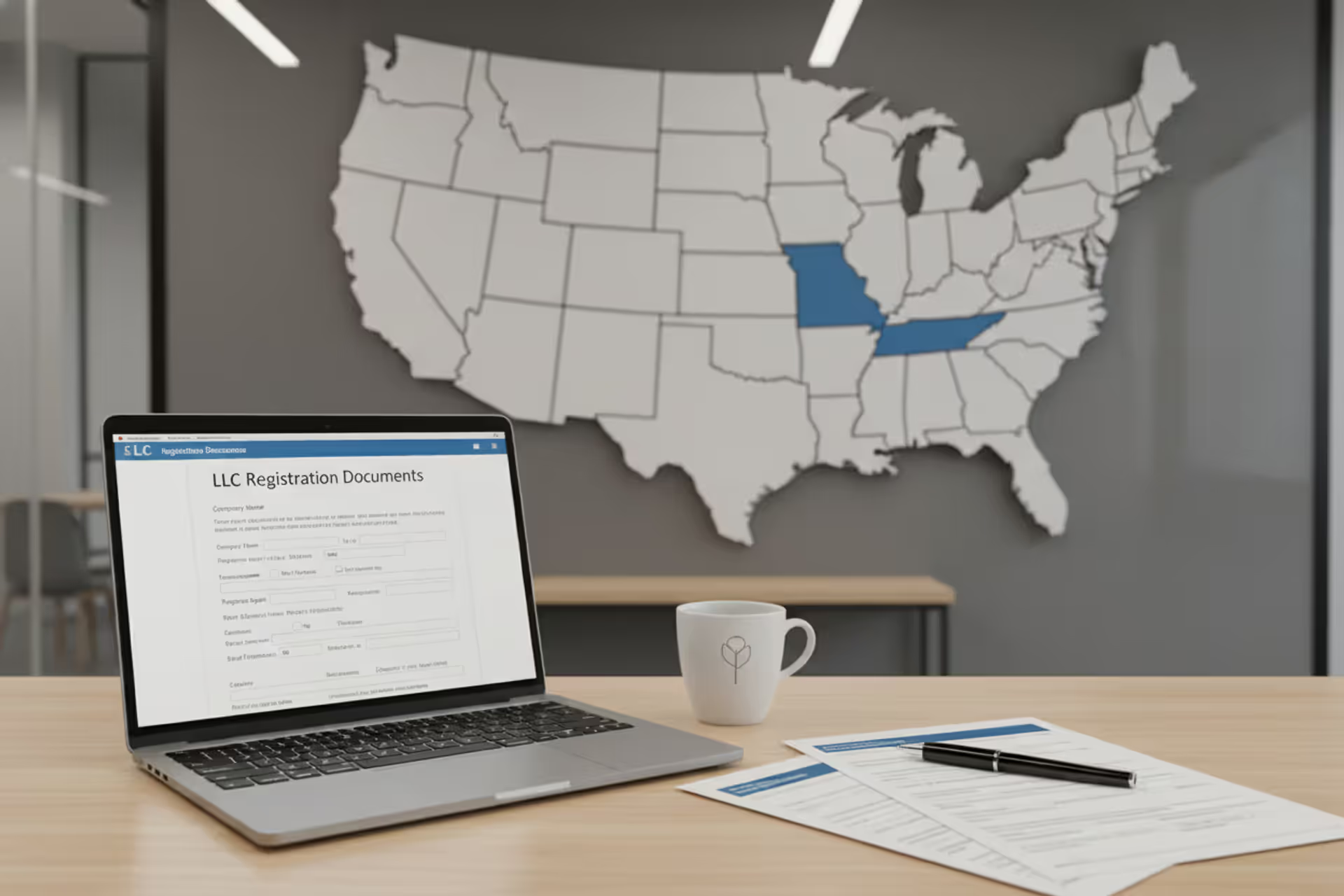
Business owner reviewing LLC formation documents and EIN paperwork at desk
Do I Need an EIN for My LLC?

Your state just approved your LLC formation paperwork. You've got your official documents. You're officially in business.
But there's another number you might need to track down—one that comes from the IRS, not your state. Whether you actually need it depends entirely on how you plan to run your company.
This federal identifier—the Employer Identification Number—is mandatory for some LLCs and completely optional for others. The confusing part? Even businesses that can legally skip it usually end up getting one anyway because of practical banking and operational requirements.
I'm going to break down the exact circumstances that trigger the legal requirement, explain when you can technically avoid getting one, and show you why most LLC owners choose to apply regardless of what the tax code requires. By the end, you'll know exactly whether your business needs this number and how to avoid common compliance problems.
What Is an EIN and How Does It Work for LLCs
An EIN functions like a Social Security Number designed specifically for your company. The format looks like this: 12-3456789, always nine digits with a hyphen after the first two.
The IRS assigns this identifier to track your business's tax activities. Every time you file a business tax return, they log it against this number. Pay employment taxes? Same identifier. When vendors prepare 1099 forms documenting payments they made to your company, they'll need this number to complete those forms correctly.
Financial institutions rely on EINs too. Try opening a business checking account, and the bank will request this number so they can report any interest your account earns.
Here's something that confuses people: you can get an EIN even if the IRS doesn't treat your LLC as a separate tax entity. Single-owner LLCs automatically operate as "disregarded entities" for federal tax purposes, which means business income flows directly to your personal Form 1040. Multi-owner LLCs default to partnership tax treatment. But in both scenarios, you're still eligible to obtain—and often required to use—an EIN.
The IRS issues your number permanently. No expiration dates. No annual renewals. If you shut down this LLC and launch a completely different company later, you'll apply for a brand-new EIN for that separate business.

Author: Olivia Carrington;
Source: worldwidemediums.net
When an LLC Is Required to Have an EIN
Let me cut through the confusion: certain situations create an absolute legal obligation to obtain an EIN. No wiggle room.
Single-Member LLCs vs Multi-Member LLCs
Operating your LLC with any co-owner—whether it's a 50-50 partnership or someone holding just 2% ownership—creates an immediate EIN requirement. No exceptions.
The IRS automatically classifies multi-member LLCs as partnerships for tax purposes. Partnership entities must file Form 1065 annually. This return won't process if you submit it with a Social Security Number—the form explicitly requires an EIN in the identification section.
Sole owners face different rules. When you're the only person listed on your LLC's ownership records and you haven't brought anyone onto your payroll, the IRS considers your company a "disregarded entity." Business profits appear directly on Schedule C of your personal tax return. In this narrow scenario, federal tax law permits you to operate using just your Social Security Number rather than obtaining an EIN.
Here's the critical exception: choosing corporate tax classification changes everything. Single-member LLCs that submit Form 8832 to elect C corporation status must obtain an EIN. File Form 2553 requesting S corporation treatment? Same requirement kicks in. Corporate tax returns—whether Form 1120 or Form 1120-S—cannot be submitted without an EIN.
Hiring Employees or Contractors
Bringing your first person onto the payroll immediately creates an EIN requirement, regardless of LLC size or structure.
Doesn't matter if you hired a part-time assistant working twelve hours weekly or built a team of thirty people. One single employee on your books triggers the federal mandate.
The reason? Employment tax obligations. You're now responsible for withholding amounts from employee paychecks for federal income tax, Social Security contributions, and Medicare. Each quarter, you'll file Form 941 to report these withholdings. At year-end, you'll submit Form 940 for unemployment tax. Both forms require an EIN—they won't accept Social Security Numbers.
Independent contractor relationships occupy a murkier zone. Simply making payments to contractors doesn't automatically trigger the EIN requirement. However, once your total payments to any individual contractor reach $600 during the tax year, you're obligated to file Form 1099-NEC. Nearly all banks and payment platforms require an EIN before they'll help you generate those 1099 forms.
Additional situations that create non-negotiable EIN requirements:
- Excise tax obligations: Your LLC manufactures or sells products like firearms, motor fuels, alcoholic beverages, or tobacco products? The excise tax returns for these industries require an EIN.
- Keogh retirement accounts: Establishing this specific type of qualified retirement plan creates an automatic EIN requirement.
- Trust or estate members: When a trust or estate appears on your LLC's ownership roster, you must obtain an EIN.
Situations Where an EIN Is Optional but Recommended

Author: Olivia Carrington;
Source: worldwidemediums.net
The law might give you a choice, but real-world business operations often eliminate that choice pretty quickly.
Banking access becomes your first major obstacle. I contacted eight national banks last quarter to ask about their LLC account policies. Seven maintained firm policies requiring EINs for all business accounts—they wouldn't even discuss alternatives. The eighth bank technically allowed single-member LLCs to open accounts using the owner's Social Security Number, but their process involved additional verification steps, branch manager sign-off, and restricted account features. Their banking officer told me directly: "We process about four SSN-based LLC accounts per year versus hundreds with EINs—getting the EIN just works better."
Establishing business credit depends on creating a financial identity completely separate from your personal credit profile. The three major business credit bureaus—Dun & Bradstreet, Experian Business, and Equifax Business—build their entire reporting system around EINs. Apply for a business credit card or equipment loan using your EIN? You're building your LLC's independent creditworthiness. Submit applications using your SSN instead? Everything lands on your personal credit report, which defeats the liability protection purpose of forming an LLC in the first place.
Personal privacy protection deserves more attention than it typically gets. Every business relationship requires sharing some form of identification for tax reporting. Last year, my marketing LLC contracted with 52 different clients and vendors. Without an EIN, I would have shared my Social Security Number with 52 separate organizations—each one representing a potential data breach or identity theft risk. Using my EIN instead kept my personal identifier completely private.
Wholesale accounts and trade suppliers routinely demand Tax ID numbers during onboarding. Try creating a seller account on platforms like Alibaba, Faire, or Wholesale Central without one—most won't let you proceed past the registration page. Business-tier accounts with payment processors like Stripe, Square, or PayPal? They require Tax IDs before approving your account.
Planning ahead prevents bottlenecks. You might be working solo today with no immediate hiring plans. But what happens eight months from now when you land a big contract and suddenly need help fulfilling it? Obtaining an EIN can take several weeks through certain application methods, and you'll need that number active in the system before processing your first payroll. Securing it now eliminates that potential delay when you're trying to move quickly.
| LLC Scenario | EIN Mandatory? | Explanation |
| Single owner, zero staff, default tax treatment | No | Permitted to operate as disregarded entity using owner's SSN |
| Two or more owners (any percentage split) | Yes | Partnership tax returns cannot be filed without EIN |
| Any staff members receiving W-2 wages | Yes | Payroll tax reporting and deposits require EIN |
| Elected corporate tax status (C corp or S corp) | Yes | Corporate return filings demand EIN |
| Pays federal excise taxes | Yes | Excise tax forms require EIN in identification section |
| Needs business bank accounts | Not legally required but practically essential | Vast majority of banks require or heavily prefer EINs |
| Wants to build independent business credit | Optional but strongly beneficial | Business credit bureaus track company credit using EIN |
How to Get an EIN for Your LLC
The IRS offers three application methods: online submission, postal mail, or fax transmission. Let me save you time—the online option beats the others in almost every situation unless you're applying from outside the United States.
The online process costs absolutely nothing, operates Monday through Friday from 7 AM to 10 PM Eastern time, and delivers your EIN the moment you complete the application. You'll answer roughly fifteen questions covering your LLC's official legal name, the date your state approved your formation, your state of organization, your business mailing address, and the "responsible party's" identification details.
Who qualifies as the responsible party? Typically the owner or manager who maintains control over the LLC's financial decisions and asset management. This selection matters because that individual's Social Security Number gets permanently attached to your EIN in IRS databases. Changing it later means canceling your current EIN and applying for a replacement—a hassle you want to avoid.
With your documents ready, expect to spend 10-15 minutes completing the application. The final screen displays your assigned EIN along with a downloadable confirmation document formatted as an official PDF with IRS branding. Download that confirmation immediately—you get exactly one opportunity. The IRS system doesn't allow you to log back in later to retrieve it again.
Submitting Form SS-4 by mail works if you're comfortable waiting. Complete the paper form, sign it, and mail it to the processing address listed in the current instructions (the address varies depending on your state location). Plan on four to six weeks before your confirmation arrives in your mailbox.
Faxing Form SS-4 falls between the other two options for speed—quicker than mail, slower than online. Send your completed form to the fax number printed in the form instructions. The IRS typically responds within four business days by fax.
International applicants without US Social Security Numbers or Individual Taxpayer Identification Numbers must phone the IRS directly at 267-941-1099. Lines operate weekdays from 6 AM to 11 PM Eastern. International calling rates apply, and wait times can run long during peak tax season.
Before starting your application, collect these details:
- Your LLC's complete legal name exactly as it appears on your filed Articles of Organization (every word, every comma)
- Physical business address where you operate
- County and state where your principal business location sits
- Responsible party's complete legal name plus their SSN or ITIN
- The exact date your state filed and approved your LLC formation documents
- Total number of members in your LLC
- Specific description of your main business activity (detailed descriptions work better than vague categories—"commercial HVAC system installation and maintenance" works better than "contracting")
Non-negotiable rule: your LLC must legally exist before you apply. You need an actual, documented formation date from your state filing office. Attempting to secure an EIN before submitting your Articles of Organization creates documentation conflicts you absolutely want to avoid.

Author: Olivia Carrington;
Source: worldwidemediums.net
Common Mistakes LLC Owners Make With EINs
Operating with your SSN when federal law requires an EIN creates compliance problems that escalate quickly. I've consulted with multiple multi-member LLCs that attempted filing their partnership tax returns using an owner's Social Security Number. The IRS processing system rejected every single return. Several companies faced late-filing penalties. All of them had to rush EIN applications, file amended returns, and update their state registrations. Complete disaster that could've been avoided with fifteen minutes of upfront work.
Jumping the gun on applications generates unnecessary complications. One client got so excited about starting his LLC that he applied for his EIN in mid-December. He didn't actually file his Articles of Organization with the state until mid-January. Now he's holding an EIN linked to a formation date that conflicts with his official state records. The discrepancy created problems when he tried opening a business bank account. Resolving the mismatch with the IRS took nearly four weeks.
Submitting inaccurate information on your application creates persistent headaches. Misspell your LLC's legal name by one letter? Put down the wrong ZIP code? Your EIN confirmation letter won't align with your formation paperwork. Banks spot these mismatches during account setup and reject your application. Fixing errors means calling the IRS Business & Specialty Tax Line at 800-829-4933, surviving the hold queue, explaining what went wrong, and hoping for quick resolution. The process sometimes drags on for weeks.
Misplacing your confirmation document happens far more often than it should. The IRS mails you one copy of your CP 575 or 147C confirmation letter. Lose it? There's no simple "download another copy" button. You'll call the IRS, verify your identity through their security questions, and request a replacement sent by mail or fax. If the responsible party listed on your application left the company or changed addresses? The replacement process gets even more complex.
Take this action immediately after receiving your EIN: save the PDF confirmation in at least three separate locations (cloud storage, computer hard drive, email), print two physical copies, and snap a photo on your phone. Store one printed copy with your LLC formation paperwork, secure the second copy somewhere separately, and maintain digital backups across multiple platforms.
Mixing up federal EINs with state tax identifiers confuses businesses operating across multiple states. Your EIN is a single federal number that works everywhere in the country. Many states issue completely separate tax identification numbers for sales tax collection, unemployment insurance, or state income tax withholding. These are distinct numbers serving different purposes. Launch operations in California, Texas, and New York? You'll manage one federal EIN plus three different state tax ID numbers—six total if all three states require separate unemployment and sales tax registrations.
Every single LLC client gets the same advice from me: obtain your EIN immediately, even when federal law doesn't technically require it. The advantages—particularly for banking relationships and personal privacy—dramatically outweigh the 20 minutes you'll invest in the application. I've counseled too many business owners who panicked when they needed to bring on their first employee suddenly or discovered their bank wouldn't open accounts without an EIN. Complete the application early while you're setting up other business systems. It costs nothing and prevents future emergencies
— Marcus Chen
FAQ
So does your LLC actually need an EIN? Sometimes it's a legal mandate. Sometimes it's technically optional but practically essential.
Legally required scenarios: multi-member LLCs, any LLC with employees, LLCs that filed for corporate tax treatment. In these situations, obtaining an EIN isn't really a choice—it's a federal tax compliance requirement.
Technically optional scenarios: single-member LLCs operating without employees and maintaining default disregarded entity status. These businesses can legally conduct operations using the owner's Social Security Number for tax purposes.
But here's what I've observed after helping hundreds of LLCs get started: from a practical standpoint, nearly every LLC benefits from securing an EIN. The application costs nothing. The process takes less time than your average lunch break. It prevents banking roadblocks, shields your personal information from unnecessary exposure, and eliminates future panic when you hire your first team member or bring on a business partner.
Evaluate your LLC's current structure and where you realistically see your business heading in the next six to twelve months. Any possibility you'll add staff, elect S corporation tax status, or apply for business financing? Secure your EIN today. That small time investment now prevents weeks of delays later when you're trying to move quickly.
Running a genuinely solo operation that will definitely stay solo indefinitely with absolutely zero employees and no plans for tax election changes? Operating with your Social Security Number remains legally acceptable. Just fully understand what you're accepting: severely limited banking options, ongoing privacy risks every time you share your SSN, and the requirement to get an EIN the instant any circumstance changes.
The overwhelming majority of LLC owners discover that obtaining an EIN—whether legally mandated or not—stands among the simplest, highest-value administrative tasks they complete during business formation. Zero cost. Basic documentation required. Benefits that multiply as your business develops and expands.
Related Stories

Read more

Read more



The content on this website is provided for general informational and educational purposes only. It is intended to explain concepts related to Limited Liability Companies (LLCs), including formation, management, taxation, compliance, and business structuring.
All information on this website, including articles, guides, templates, and examples, is presented for general educational purposes. LLC requirements and regulations may vary depending on individual circumstances, business activities, state laws, and jurisdiction.
This website does not provide legal, tax, or financial advice, and the information presented should not be used as a substitute for consultation with qualified legal, tax, or financial professionals.
The website and its authors are not responsible for any errors or omissions, or for any outcomes resulting from decisions made based on the information provided on this website.