

Empty small business desk with tax documents and laptop in an inactive LLC setting
How to File Taxes for LLC With No Income?

Content
Content
Your LLC sat idle all year. Not a single customer. Zero sales. Bank account as empty as the day you opened it. So you're off the hook for taxes, right?
Wrong. Dead wrong, actually.
Most states and the IRS want paperwork from you whether your business made money or not. I've watched entrepreneurs rack up thousands in penalties because they thought "no money in" meant "no forms out." The IRS doesn't care if your brilliant business idea is still gestating—once you've registered that entity, you've signed up for filing obligations that stick around even during dormant years.
Here's what trips people up: LLCs don't fit into a neat tax box. Your company passes its financial results through to you (the owner), which means the paperwork requirements shift based on how many owners you have and which tax elections you made when setting things up. Choose the wrong approach—or ignore the whole thing entirely—and you'll pay for it later.
Are LLC Tax Filings Required When You Earned Nothing?
Federal requirements hinge entirely on your company's structure. State rules? Those follow their own logic, usually involving fees they'll collect regardless of your revenue.
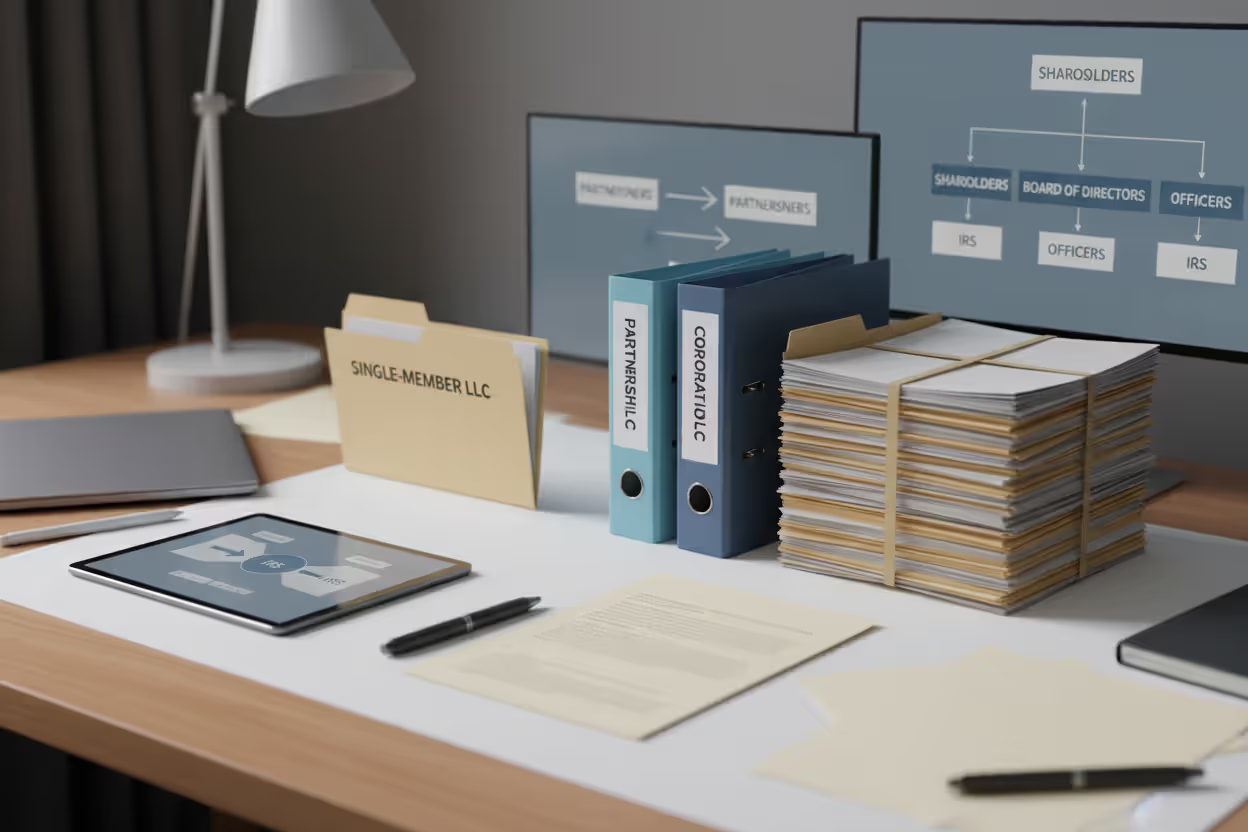
The tax agency treats your LLC as either a sole proprietorship (one owner), partnership (multiple owners), or corporation (if you specifically asked for that treatment). They don't have an "LLC" checkbox on their forms. This classification controls whether filing is optional or absolutely mandatory.
One owner? Your LLC vanishes for tax purposes—the IRS calls this "disregarded entity" status. Everything flows onto Schedule C attached to your personal 1040. Technically, if you earned zilch and spent zilch, you can skip Schedule C entirely. But here's the rub: any business expenses you paid—state fees, legal bills, website hosting—those disappear unless you file. Plus, you're leaving no trace that your business existed, which raises eyebrows if auditors come knocking later or if you claim startup deductions down the road.
Multiple owners? Form 1065 becomes non-negotiable. The IRS expects partnership returns even if you conducted zero transactions. Miss this deadline and penalties auto-generate at $220 per owner monthly, maxing out at twelve months. Two partners filing six months late? That's $2,640 in fines despite owing zero tax dollars. The IRS has made this penalty structure particularly aggressive to force compliance.
Corporate election? Once you've submitted Form 2553 (S-corp) or Form 8832 (C-corp), you're locked into corporate filing mandates. Form 1120-S or Form 1120 must land on the IRS's desk annually. No income? Doesn't matter. These entities exist separately from their owners in the tax agency's eyes, creating independent filing obligations that persist through inactive periods.
Author: Kevin Halbrook;
Source: worldwidemediums.net
States layer on their own demands. California hits most LLCs with an $800 franchise tax annually (waived only your first year), and you'll file Form 568 to document that payment. Delaware wants annual reports and franchise taxes. New York requires biennial filings. Each jurisdiction writes its own rules, sets its own thresholds, and charges its own penalties. Federal compliance won't satisfy state requirements.
Skipping tax filings for inactive companies isn't just a tax issue—it threatens your entity's legal status. Administrative dissolution by the state means losing liability protection, potentially exposing personal assets to business debts
— Jennifer Kalloway
Your LLC's Tax Classification Explained
How the IRS categorizes your company determines every filing requirement you'll face. They've given you flexibility in choosing, but that freedom creates responsibility.
Single-owner LLCs automatically become disregarded entities unless you elect otherwise. The government ignores your LLC structure entirely and treats all activity as self-employment income reported via Schedule C. You file as if the LLC doesn't exist for tax purposes.
Multiple-owner LLCs default to partnership taxation. Form 1065 becomes mandatory, along with Schedule K-1s distributing each member's share of profits, losses, credits, and deductions. Even with zero activity, these forms must be prepared and submitted.
These defaults work fine for most businesses, but you're not stuck with them. File Form 8832 and you can elect C-corporation treatment. Submit Form 2553 and you'll get S-corporation status. Both elections trigger corporate filing requirements immediately—you can't casually revert to default treatment later without IRS approval and potential tax consequences.
S-corporation status appeals to profitable LLCs because it potentially reduces self-employment tax on earnings. But that election creates year-round obligations: processing payroll, filing quarterly Form 941, issuing W-2s to owner-employees, and submitting Form 1120-S regardless of revenue. Choosing S-corp treatment for a dormant LLC creates headaches without benefits.
C-corporation treatment makes sense primarily when seeking venture capital or planning to retain significant earnings for reinvestment. The double taxation structure (corporate-level tax plus shareholder dividend tax) and mandatory Form 1120 filing make this classification unattractive for inactive entities.
Most inactive LLCs benefit from maintaining default classification. If you elected corporate treatment before realizing your business would stay dormant, you're stuck with those filing requirements until you formally revoke the election or dissolve the entity entirely.
Filing Steps for Inactive LLCs
Getting your paperwork right requires identifying the correct forms, gathering documentation, and hitting deadlines specific to your classification.
Federal Requirements
Single-owner LLCs (disregarded):
You'll work with Schedule C attached to Form 1040. Fill in your LLC's name and EIN at the top. Part I asks about gross receipts—enter zero. Part II lists expense categories. Even with no revenue, you can claim state filing fees, registered agent charges, professional consultations, or business insurance premiums. The resulting loss flows to Form 1040's main calculation, potentially reducing your total taxable income.
Completely zero activity—no income, no expenses? Schedule C becomes technically optional. But filing anyway creates documentation that your LLC existed and remained inactive rather than leaving auditors wondering why an entity with an EIN never surfaced on tax returns. This becomes valuable if you're audited or when you later claim expenses associated with starting the business.
Multiple-owner LLCs (partnerships):
Form 1065 is mandatory, period. Complete the identification section with your LLC's details. Schedule B asks questions about partnership activities—check "yes" indicating the partnership had no business activity. Schedule K summarizes partners' shares of income and deductions, showing zeros across all categories. Prepare Schedule K-1 for each owner documenting their ownership percentage and zero allocations for income and loss items.
The March 15 deadline (or the 15th day three months after your fiscal year ends) is firm. Missing it triggers immediate penalties even though you owe no tax.
S-corporations:
Form 1120-S demands more detail than partnership filings. Complete all required schedules documenting zero income, any expenses you incurred, and zero distributions. Issue Schedule K-1 to each shareholder. The March 15 deadline applies here too. If you paid yourself wages—which you shouldn't have with no income—quarterly Form 941s and annual W-2s become additional requirements.
C-corporations:
Form 1120 comes due April 15 (or the 15th day four months after your fiscal year closes). Complete required schedules reflecting zero activity. C-corporation returns involve more complexity than other formats, making professional assistance worthwhile even for zero-income filings.
State Requirements
State obligations vary wildly. Some require annual reports distinct from tax returns. Others combine both. A handful impose minimum taxes unrelated to income.
Visit your Secretary of State's website and your Department of Revenue site for specifics. California LLCs submit Form 568 and pay that $800 franchise tax. New York LLCs file Form IT-204-LL when New York members are involved. Texas charges no income tax but demands a Public Information Report.

Author: Kevin Halbrook;
Source: worldwidemediums.net
Many states offer online filing for annual reports—faster than paper forms. Set calendar alerts for these deadlines, which often differ from federal due dates. Missing them can result in administrative dissolution of your LLC.
Tax Forms Used for Zero-Revenue Returns
Your filing paperwork depends completely on how the tax agency classifies your business. Here's how the main forms compare:
| LLC Structure | Federal Form | Must You File? | Deadline |
| Single-Owner (Disregarded) | Schedule C (attached to 1040) | Optional when both income and expenses are zero | April 15 |
| Multiple-Owner (Partnership) | Form 1065 plus Schedule K-1 | Yes, regardless of activity | March 15 |
| S-Corporation | Form 1120-S plus Schedule K-1 | Yes, regardless of activity | March 15 |
| C-Corporation | Form 1120 | Yes, regardless of activity | April 15 |
Schedule C connects to your personal tax return, documenting profit or loss from self-employment or single-owner LLC activity. Even without revenue, Part II lets you list expenses, generating a loss that decreases taxable income from other sources. The form spans just two pages covering income sources and expense categories.
Form 1065 runs considerably longer. You'll handle the main form plus Schedule B (partnership structure questions), Schedule K (summary of all partners' income/deduction shares), Schedule L (balance sheet), Schedule M-1 (income reconciliation), and Schedule M-2 (partners' capital accounts). Zero activity doesn't eliminate these schedules—you must complete them to satisfy filing requirements.
Form 1120-S matches Form 1065's complexity level. Similar schedules including balance sheets and reconciliations are required. S-corporations must also track accumulated adjustments accounts and other equity accounts that partnerships don't monitor.
Form 1120 for C-corporations includes the most extensive schedules and demands the most detailed financial reporting. The balance sheet requirement means tracking assets and liabilities even during dormant periods.
IRS.gov provides all these forms as free PDFs. Most tax software packages generate them automatically. For straightforward single-owner situations, free IRS Free File software might suffice. Partnerships and corporations typically involve enough complexity to justify either paid software or professional preparation.
What Happens When You Don't File
Ignoring tax filing requirements for an inactive LLC creates problems costing far more than compliance would.
Federal penalties start with late-filing charges. Partnerships (Form 1065) face $220 per partner monthly (or partial month) when late, capping at twelve months. Two partners filing three months late? That's $1,320 in penalties despite zero tax liability. S-corporations face identical penalty structures on Form 1120-S.
Single-owner LLCs treated as disregarded entities face lighter federal penalties for skipping Schedule C, but they forfeit the chance to deduct expenses and document their business's existence. If the IRS later questions unreported income or argues you ran a hobby rather than a legitimate business, you'll have no filing history as evidence.
State penalties vary but often hit hard. California charges $18 monthly for late franchise tax returns, but more critically, it can suspend or forfeit your LLC for non-filing. Once suspended, you legally cannot conduct business, and your limited liability protection evaporates. Reinstating a suspended LLC demands paying all back taxes, penalties, interest, plus a reinstatement fee.
Administrative dissolution represents the worst outcome. When states dissolve your LLC for non-compliance, the entity stops existing legally. Liability protection disappears, sometimes retroactively depending on jurisdiction. If someone sues your business, they can potentially pierce the dissolved entity and pursue personal assets. Reestablishing the LLC means filing new formation documents, obtaining a new EIN, and basically starting over—while still owing penalties from the dissolved entity.
Credit and compliance complications emerge when you need to prove your business exists. Banks may freeze accounts for entities missing required returns. Vendors may refuse credit. Later applications for business loans or investor pitches raise red flags when gaps appear in your filing history, signaling poor management.
Do the math: filing a zero-income return costs maybe a few hundred dollars with professional help, or just your time if self-prepared. Penalties and reinstatement fees easily exceed $1,000, and you'll still need to file those delinquent returns eventually anyway.

Author: Kevin Halbrook;
Source: worldwidemediums.net
Expenses You Can Deduct Despite Zero Income
No revenue doesn't equal no deductions. Your LLC probably incurred costs even during dormancy, and those expenses can slash taxable income from other sources or carry forward to offset future profits.
Startup costs qualify for immediate deduction up to $5,000 in your first active year, with remaining costs amortized across 180 months. Money spent researching your business model, traveling to evaluate potential locations, or consulting with advisors before officially launching? Those qualify. You must start claiming this deduction the year your business becomes active, which might be a zero-income year.
Organizational expenses for forming your LLC—state filing fees, legal fees drafting your operating agreement, accounting fees establishing your books—get similar treatment: $5,000 immediate deduction, remainder amortized.
Operating expenses count even without corresponding revenue. Your state's annual LLC fee, registered agent fees, business liability insurance premiums, professional association memberships, domain registration, website hosting, and business license renewals all qualify as ordinary and necessary expenses. A home office used exclusively for business might qualify you for the home office deduction calculated by square footage or the simplified option (currently $5 per square foot, maxing at 300 square feet).
Professional fees for tax prep and legal guidance count as deductible. Paid a CPA to prepare your zero-income return? Attorney reviewed a contract you ultimately didn't sign? Those costs reduce taxable income.
Interest and fees on business credit cards or loans remain deductible regardless of revenue. Carrying debt from initial startup purchases? That interest expense generates a loss offsetting other income.
Document everything meticulously. Save receipts, bank statements, and credit card statements proving business expenses. The IRS may question whether an entity without income really operated as a business versus a hobby, so maintaining detailed records proves your profit motive and business intent.

Author: Kevin Halbrook;
Source: worldwidemediums.net
Losses from inactive years create net operating losses (NOLs) carrying forward to offset future profits. Current rules allow NOLs to carry forward indefinitely, though they're capped at offsetting 80% of taxable income in any given year. That loss you claim during dormancy could save thousands in taxes once your business becomes profitable.
Common Questions About Filing for Inactive LLCs
Filing taxes for an inactive LLC feels like bureaucratic busywork, but it's a legal requirement protecting your business entity and preventing expensive penalties. The specific forms and deadlines depend on how the tax agency classifies your LLC—disregarded entity, partnership, S-corporation, or C-corporation—and each brings different obligations.
Single-owner LLCs enjoy the most flexibility, with optional federal filing when truly dormant, though submitting Schedule C creates valuable documentation. Multiple-owner LLCs, S-corporations, and C-corporations must file regardless of income, with automatic penalties triggering when deadlines pass. State requirements add complexity, with many states demanding annual reports or returns even when federal filing is optional.
Compliance costs—a few hundred dollars and several hours—pale compared to penalties potentially reaching thousands, plus the risk of administrative dissolution eliminating your liability protection. Even during zero-income years, you can deduct startup costs, organizational expenses, and operating costs that reduce your overall tax burden or carry forward to offset future profits.
Set up systems now: mark filing deadlines on your calendar, organize receipts and documentation throughout the year, and decide whether you'll self-file or hire a professional. Maintaining compliance during inactive periods keeps your LLC in good standing and ready to operate when opportunities arrive.
Related Stories

Read more

Read more



The content on this website is provided for general informational and educational purposes only. It is intended to explain concepts related to Limited Liability Companies (LLCs), including formation, management, taxation, compliance, and business structuring.
All information on this website, including articles, guides, templates, and examples, is presented for general educational purposes. LLC requirements and regulations may vary depending on individual circumstances, business activities, state laws, and jurisdiction.
This website does not provide legal, tax, or financial advice, and the information presented should not be used as a substitute for consultation with qualified legal, tax, or financial professionals.
The website and its authors are not responsible for any errors or omissions, or for any outcomes resulting from decisions made based on the information provided on this website.