

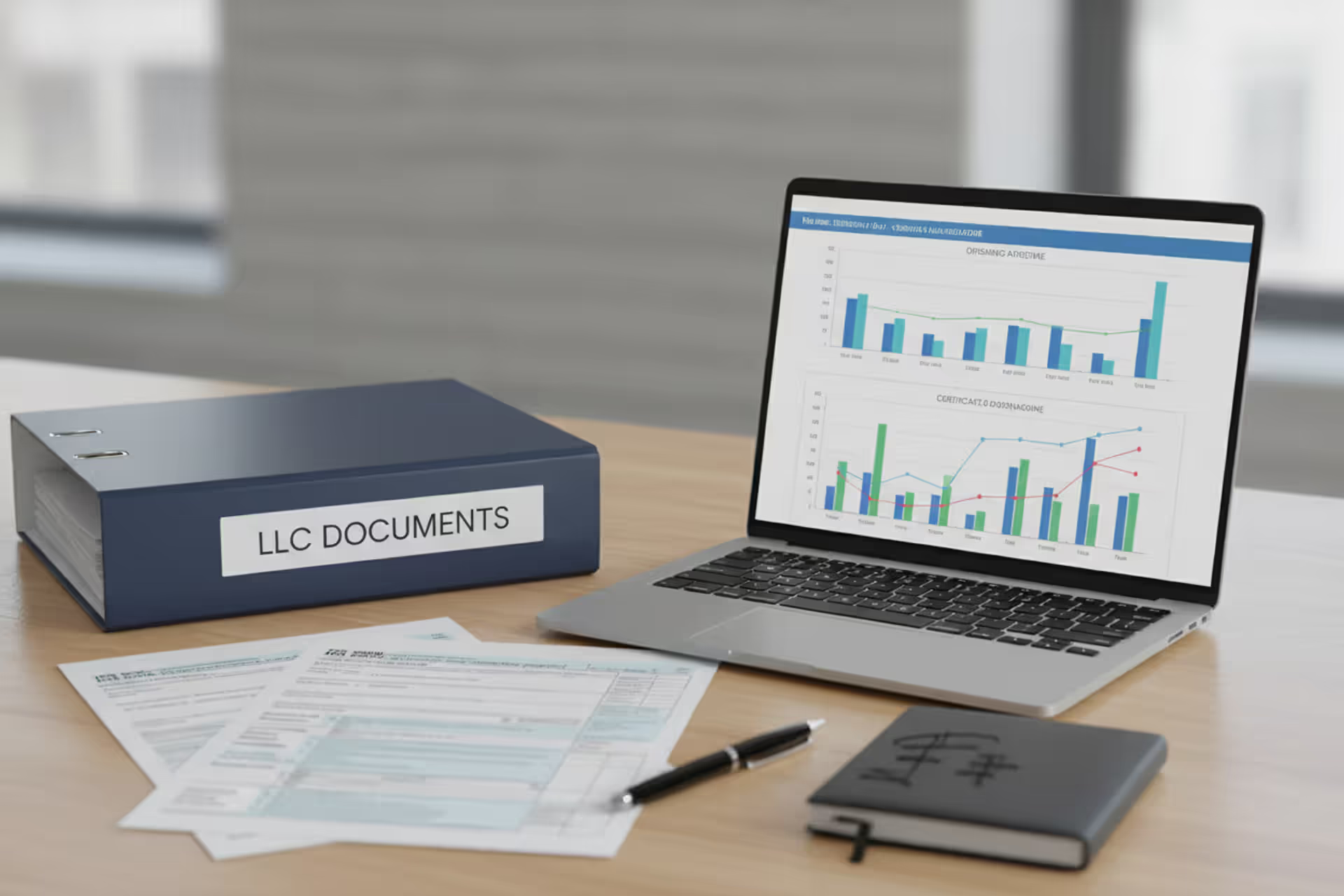
Small business owner workspace with laptop, tax documents and financial records
How to Pay LLC Taxes in the United States?

Running an LLC means juggling tax responsibilities that shift based on how you've structured your company. You'll calculate what you owe, figure out when payments are due, and choose from several payment methods—none of which the IRS will remind you about. Your tax bill depends on whether you're the sole owner or share the business, your annual revenue, and which state issued your business license.
This guide walks through the actual mechanics: determining your rate, running the numbers, and getting money to the IRS before deadlines hit.
Do LLCs Pay Taxes? Understanding LLC Tax Structure
Here's the quirk: the federal tax code doesn't have a special category for LLCs. The government looks at your ownership setup and drops you into an existing bucket. Own the LLC yourself? You're filing as a sole proprietor. Split ownership with partners? That's partnership taxation. The common thread: the company doesn't cut a check to the IRS for income taxes.
Money flows straight through to whoever owns the business. Your share of profits lands on your personal 1040, whether you pulled that cash out of the business account or left it sitting there. A single owner attaches Schedule C to their individual return, listing all business income and expenses. Multiple owners get a different path—the LLC files Form 1065 as an informational document, then sends each owner a K-1 showing their slice of profits or losses. Those owners transfer their K-1 numbers onto their personal returns.
You're not locked into this default setup. Submit Form 2553 and you're operating as an S corporation for tax purposes, which changes how self-employment tax hits your income. Or file Form 8832 to become a C corporation, putting the business itself on the hook for corporate tax rates. Some owners pick C corp status when they're keeping most profits in the business for expansion rather than taking distributions.
One surprise catches new owners off guard: you're taxed on your ownership percentage of profits even if you don't distribute that money. Your LLC nets $120,000 this year but you only withdrew $50,000? The IRS expects tax on the full $120,000 based on your ownership stake.

Author: Samantha Rowe;
Source: worldwidemediums.net
Federal LLC Tax Rate and How It's Determined
Your tax rate swings wildly depending on which classification you're using and what else shows up on your personal tax return.
Standard single-owner and multi-owner LLCs: You're paying individual income tax rates, currently spanning from 10% up to 37% as of 2026. These brackets are marginal—hitting the 37% bracket doesn't mean your entire income gets taxed at that rate. The first chunk gets taxed at 10%, the next portion at 12%, climbing up as income rises. Someone earning $100,000 in taxable income isn't handing over $37,000. Their real rate—what they actually pay divided by income—lands much lower because those initial dollars face the gentle 10% rate.
S corporation classification: Profits still flow through to your personal return, hitting those same individual brackets. The twist: you must pay yourself wages for work you actually do, with normal payroll taxes withheld. The remaining profit passes through without triggering self-employment tax. For profitable LLCs, this split cuts your total tax compared to default treatment.
C corporation classification: The entity itself pays 21% corporate tax on profits. Then, when you take distributions as dividends, you're taxed again at qualified dividend rates—0%, 15%, or 20% based on your income level. This double-hit explains why most small operations skip C corp status unless unusual circumstances create an advantage.
On top of income tax, LLC owners typically face self-employment tax: 15.3% on net earnings up to $168,600 (the 2026 Social Security wage base), dropping to 2.9% above that threshold. Once your income crosses $200,000 (or $250,000 for married couples filing together), you're paying an extra 0.9% Medicare surtax.
Your actual rate combines these pieces. Picture a solo LLC owner netting $90,000 in profit. They'd pay roughly $12,700 for self-employment tax, plus about $9,500 in federal income tax after the standard deduction. Combined effective rate: around 24%. But that shifts based on what deductions you can claim and which credits apply to your situation.
How to Calculate LLC Taxes Step by Step
Begin with every dollar coming into your business—gross receipts from all sources. If you're selling physical products, subtract what you spent on inventory (cost of goods sold). What's left is gross income. Now deduct every legitimate business expense: office rent, supplies, advertising, professional fees, vehicle costs, health insurance premiums, retirement contributions, and equipment depreciation.
You're left with net profit. Single-member LLCs report this on Schedule C; multi-member LLCs split it among owners based on their operating agreement. This number kicks off your tax math.
Most pass-through business owners can knock off up to 20% of qualified business income before calculating tax. Phase-outs and limits apply depending on how much you earn and what type of business you run. A consultant pulling $100,000 in net profit might deduct $20,000, shrinking taxable income to $80,000 before personal deductions enter the picture.
Calculating Self-Employment Tax for LLC Members
Self-employment tax covers the Social Security and Medicare contributions that W-2 employees split with their employer. LLC members are both sides of that equation, so they're paying the full freight: 15.3%.
Start with net earnings and multiply by 92.35%—the IRS lets you exclude 7.65% to mirror how employee-side payroll tax works. Apply the 15.3% rate to amounts up to the Social Security wage base, then 2.9% to everything above.
Here's the math on $75,000 net profit: $75,000 × 92.35% = $69,262.50 subject to SE tax. At 15.3%, you're paying $10,597 in self-employment tax. The upside: you deduct half of this ($5,299) on Form 1040, reducing adjusted gross income.

Author: Samantha Rowe;
Source: worldwidemediums.net
Higher earners hit an additional Medicare tax once combined wages and self-employment income cross the threshold. You'll calculate the 0.9% extra tax on Form 8959—it doesn't happen automatically.
Quarterly Estimated Tax Payments
Tax collection works in real-time, not once a year. Expect to owe $1,000 or more by April? You're making quarterly estimated payments. Skip them and penalties stack up even if you pay everything by April 15.
Form 1040-ES helps you project the year's income, deductions, and credits—basically creating a draft tax return. Split your expected tax into four chunks and pay by the quarterly deadlines: April 15, June 15, September 15, and January 15 of the following year.
The safer route: calculate based on last year's actual tax. Pay 100% of what you owed last year (bump to 110% if your adjusted gross income topped $150,000) and you're penalty-proof regardless of this year's income. This approach works well when income bounces around unpredictably.
First-year LLC owners frequently underpay because they don't shift from employee withholding mindset to quarterly payment discipline. Someone who spent years getting W-2 paychecks with automatic withholding might not internalize that self-employment income requires proactive quarterly payments. By December, they're facing not just the tax bill but underpayment penalties calculated separately for each quarter they shorted.
How to Pay Your LLC Taxes: Filing and Payment Methods
Payment logistics shift based on your tax classification. Single-member LLCs pay through their personal tax return (Form 1040), either when filing or via quarterly estimates. Multi-member LLCs don't pay at the entity level—individual members pay based on what their K-1 shows.
Electronic Federal Tax Payment System (EFTPS): The IRS runs this free service where you schedule payments straight from your bank account. Enrollment takes roughly a week because they mail a PIN to verify your identity. Once you're in, you can queue up payments in advance and grab confirmation receipts. Useful for quarterly estimates—schedule all four payments in January and cross it off your list.
IRS Direct Pay: Instant online payments directly from checking or savings, no waiting for enrollment. Pull up the IRS website, pick your payment type (estimated tax, balance due on return, etc.), enter bank details, and submit. You'll see instant confirmation. Works for current and prior year payments.
Credit or debit card: Third-party processors handle card payments for fees running 1.85% to 1.99% of your payment. Makes sense if you're chasing credit card rewards that exceed the fee, but most business owners skip the extra cost.
Check or money order: Mail payment with Form 1040-V (payment voucher) to the address matching your state in the form instructions—addresses vary by location. Build in several days for mail transit and processing. Write your Social Security number, tax year, and form number on the check memo line.
Same-day wire: Emergency option when you're bumping against a deadline. Your bank wires payment using IRS instructions. Expect fees around $30 to $50 depending on your bank.

Author: Samantha Rowe;
Source: worldwidemediums.net
Deadlines carry weight. Personal returns (covering single-member LLC income) come due April 15. Partnership returns (multi-member LLCs) hit March 15. Miss either and you're stacking penalties: failure-to-file runs 5% monthly up to 25%, failure-to-pay adds 0.5% monthly, plus interest on unpaid balances.
Extensions buy time to file but don't push back payment deadlines. File Form 4868 by April 15 and you get until October 15 to submit paperwork, but estimated tax owed is still due by the original deadline or penalties kick in.
State LLC Tax Obligations and Payment Procedures
State treatment varies wildly. Nine states skip income tax entirely: Alaska, Florida, Nevada, South Dakota, Tennessee, Texas, Washington, and Wyoming (New Hampshire recently joined this group). Others levy tax on LLC income anywhere from roughly 2% to 13%, either at the entity level or flowing through to members.
California slaps an $800 annual franchise tax on every LLC regardless of whether you made a dime, plus a gross receipts fee once California-sourced income exceeds $250,000. New York charges a filing fee scaled to gross income. Massachusetts hits LLCs with both a corporate excise tax and minimum annual fee.
Some states demand entity-level tax payments even for pass-through LLCs. Tennessee's franchise and excise tax applies directly to the entity. New Hampshire taxes business profits at the entity level while still respecting pass-through treatment for federal purposes.
Pull up your state's department of revenue website for specifics. Most income-taxing states mirror federal quarterly estimated payment requirements. Payment options typically include online portals, electronic funds transfer, and mailed checks.
Local taxes add another layer. Cities like New York, Philadelphia, and Detroit impose income taxes on business profits or gross receipts. These create separate filing and payment obligations on top of state and federal requirements.
Operating across state lines complicates everything. Your LLC doing business in multiple states might file returns and pay taxes wherever you have nexus—sufficient connection to trigger tax obligations. Nexus rules shift by state: physical presence, employee locations, sales volume, and other factors can flip the switch on filing requirements.
Common LLC Tax Mistakes and How to Avoid Them
The biggest mistake I see LLC owners make is treating tax payments as optional until April. The quarterly estimated tax system isn't a suggestion—it's required. Clients who ignore it often face penalties that could have been avoided with simple planning
— Jennifer Martinez
Underpaying estimated taxes: Business owners launching their first LLC often lowball quarterly payments, then face penalties plus a massive bill when filing season arrives. Pull your estimates up for review in July and adjust if income is outpacing projections. Form 1040-ES includes a worksheet for recalculating mid-year.
Missing the self-employment tax component: First-timers sometimes nail the income tax calculation but completely forget about the 15.3% self-employment tax sitting on top. This can double your expected tax bill overnight. Always build SE tax into projections and quarterly payments from day one.
Blending personal and business expenses: Swiping your business card for personal purchases (or using personal accounts for business expenses) creates documentation nightmares and audit vulnerability. The IRS might toss your deductions if you can't clearly separate business from personal use. Maintain dedicated bank accounts and credit cards for the business.
Misclassifying workers: Labeling employees as independent contractors to dodge payroll taxes invites IRS scrutiny. Getting caught means back taxes, penalties, and interest. Apply the IRS common-law test examining behavioral control, financial control, and relationship type to determine correct classification.

Author: Samantha Rowe;
Source: worldwidemediums.net
Ignoring quarterly deadlines: Some owners batch all four quarterly payments in January when preparing their tax return. This triggers underpayment penalties because payments landed late for the first three quarters. Each quarter's payment must arrive by that quarter's specific deadline.
Sloppy record-keeping: Inadequate documentation of income and expenses means missed deductions and trouble if the IRS comes knocking. Set up a system—accounting software, organized receipt folders, mileage logs—on day one of operations. Reconstructing records months later is brutal and often incomplete.
Overlooking state obligations: Zeroing in on federal taxes while ignoring state filing and payment requirements builds up penalties and interest at the state level. Some states hit harder than the IRS when you're late.
LLC Tax Classification Comparison
| Tax Classification | Tax Forms Required | Tax Rate Structure | Entity-Level Tax? |
| Single-Member LLC (default) | Schedule C attached to Form 1040 | Individual brackets (10%–37%) plus self-employment tax (15.3%) | No—flows through to owner's personal return |
| Multi-Member LLC (default) | Form 1065 partnership return, Schedule K-1 issued to each member | Individual brackets (10%–37%) plus self-employment tax (15.3%) on each owner's portion | No—flows through to members' personal returns |
| LLC electing S-Corp status | Form 1120-S, Schedule K-1 to members, W-2 for employee-owners | Individual brackets (10%–37%) on distributions; standard payroll taxes on wages only | No—flows through to members' personal returns |
| LLC electing C-Corp status | Form 1120 corporate return | 21% corporate rate, then 0%–20% dividend tax when distributing to owners | Yes—double taxation applies |
FAQ: LLC Tax Questions Answered
Handling LLC taxation well means understanding how the IRS slots your business into existing categories, calculating both income and self-employment tax accurately, and hitting quarterly payment deadlines without fail. The pass-through structure most LLCs use eliminates any separation between business and personal taxes—your LLC's bottom line directly shapes your individual tax bill.
Calculate with precision, pay ahead of deadlines, and keep organized records throughout the year. These habits prevent penalties and transform tax season from chaotic scramble into manageable routine. When your LLC grows complex—adding members, expanding across state lines, making major equipment investments—bringing in a tax professional pays for itself through smart planning and maximized deductions.
The flexibility making LLCs attractive also demands responsibility. The IRS won't send you a bill or reminder—you calculate, report, and pay proactively. Nail these fundamentals and you'll handle LLC tax obligations with confidence year after year.
Related Stories

Read more

Read more



The content on this website is provided for general informational and educational purposes only. It is intended to explain concepts related to Limited Liability Companies (LLCs), including formation, management, taxation, compliance, and business structuring.
All information on this website, including articles, guides, templates, and examples, is presented for general educational purposes. LLC requirements and regulations may vary depending on individual circumstances, business activities, state laws, and jurisdiction.
This website does not provide legal, tax, or financial advice, and the information presented should not be used as a substitute for consultation with qualified legal, tax, or financial professionals.
The website and its authors are not responsible for any errors or omissions, or for any outcomes resulting from decisions made based on the information provided on this website.