

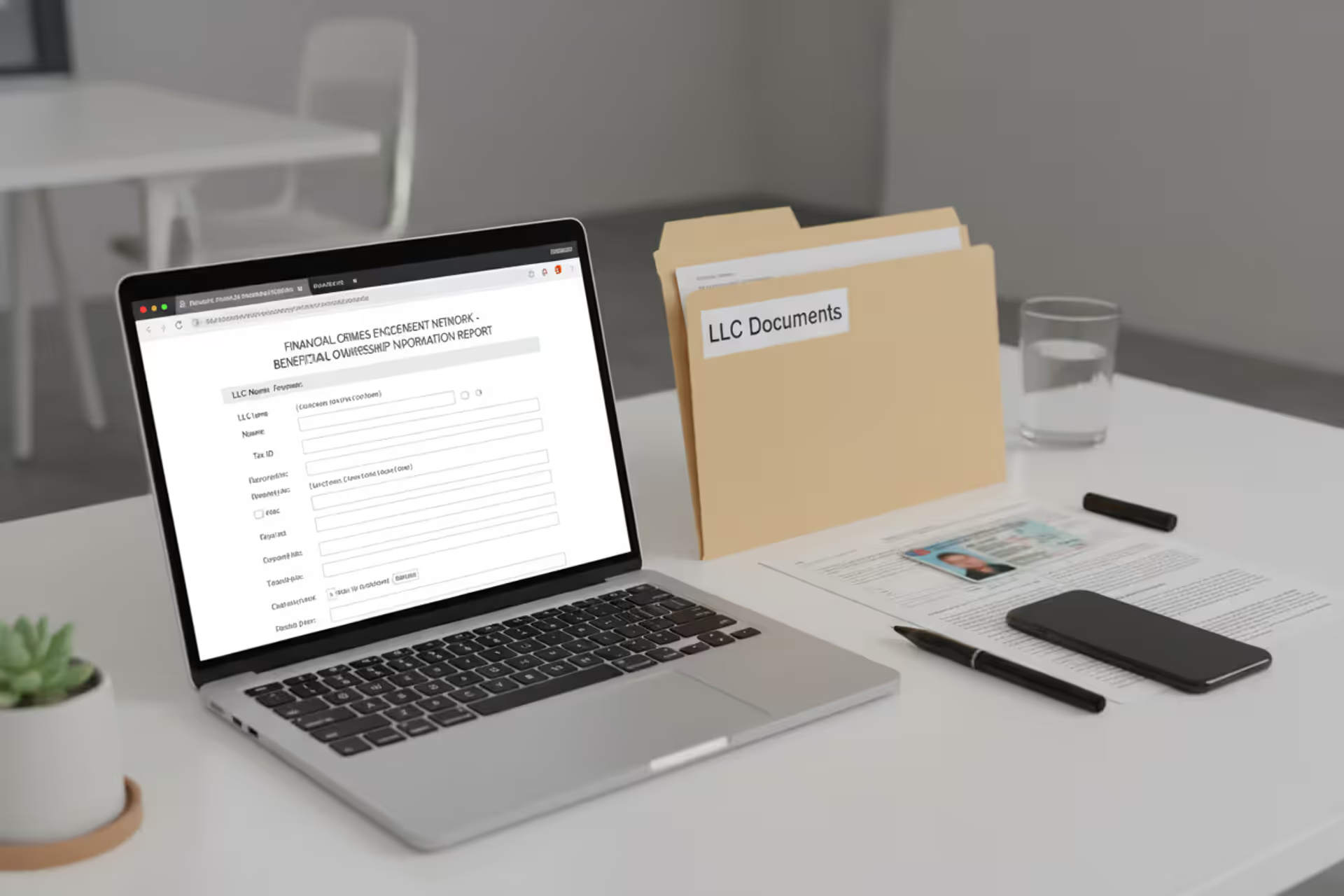
Business owner reviewing LLC registration documents with U.S. map on laptop
What Is a Foreign LLC and When Do You Need One

If you formed your LLC in Delaware but now want to open an office in Texas, you're about to encounter the concept of foreign qualification. Despite the name, a foreign LLC has nothing to do with international business—it simply refers to an LLC operating outside its home state.
Understanding when and how to register as a foreign LLC prevents costly penalties and protects your limited liability status. Many business owners discover this requirement only after receiving a cease-and-desist letter from a state agency, facing back taxes, or worse—losing a lawsuit because their LLC wasn't properly registered.
Understanding Foreign LLC vs Domestic LLC

Author: Daniel Whitlock;
Source: worldwidemediums.net
A domestic LLC is any limited liability company operating in the state where it originally filed its articles of organization. If you formed your LLC in Nevada, that LLC is domestic in Nevada.
That same Nevada LLC becomes a foreign LLC the moment it conducts business in California, Oregon, or any other state. The company itself doesn't change—only its classification relative to each state's perspective.
Think of it like residency: you're a resident in your home state and a non-resident everywhere else. Your LLC works the same way. The entity remains singular; you don't create multiple LLCs. Instead, you register your existing LLC as "foreign" in each additional state where you meet the threshold for doing business.
The distinction matters because each classification triggers different requirements. Your domestic state controls your LLC's fundamental existence—amendments to your operating agreement, changes to members, and dissolution all happen through your formation state. Foreign states only care about your activities within their borders: where you operate, who represents you there, and whether you're paying appropriate taxes and fees.
| Aspect | Domestic LLC | Foreign LLC |
| State of formation | Formed in this state | Formed in another state |
| Where it can operate | Anywhere, but must register as foreign in other states | Operating outside its formation state |
| Registration requirements | Articles of Organization | Certificate of Authority / Foreign Registration |
| Typical fees | $50–$500 initial filing | $100–$750 per state |
| Compliance obligations | Annual reports, taxes in formation state | Annual reports and taxes in both home state AND each foreign state |
When You Must Register as a Foreign LLC
States don't require foreign registration simply because you made a single sale or attended a conference. The trigger is "doing business" in a sustained, physical, or systematic way within state borders.
Registration becomes mandatory when your LLC maintains ongoing commercial activities that demonstrate a real presence. This typically includes:
- Leasing or owning office space, warehouses, or retail locations
- Employing workers who regularly perform duties in the state
- Maintaining inventory or equipment for business operations
- Opening a state-specific bank account for local transactions
- Holding in-person meetings with clients as a regular business pattern
- Operating a physical storefront or service location
The threshold varies significantly by state. Some states take an aggressive stance, requiring registration for even minimal activity. Others provide safe harbors for limited interactions.

Author: Daniel Whitlock;
Source: worldwidemediums.net
What Qualifies as "Doing Business" in Another State
Most states use a facts-and-circumstances test rather than a bright-line rule. Courts and state agencies examine the totality of your activities.
Activities that generally DO require foreign LLC registration:
- Hiring employees who work from the state regularly, even remotely
- Maintaining a warehouse or distribution center
- Providing services from a fixed location (office, clinic, studio)
- Owning real property used in business operations
- Systematic and continuous solicitation of business
Activities that typically DON'T require registration:
- Attending trade shows or conferences
- Meeting with clients or vendors occasionally
- Maintaining a website accessible to state residents
- Shipping products into the state via common carrier
- Holding bank accounts as an incidental matter
- Defending lawsuits in state courts
- Conducting isolated transactions
The line blurs with remote employees. In 2026, many states now consider a single full-time remote employee sufficient to trigger foreign qualification requirements, particularly if that employee conducts customer-facing work. A software developer working from home might not trigger registration, but a salesperson meeting clients in-state almost certainly will.
Consequences of Not Registering
States enforce foreign registration requirements through both immediate penalties and long-term consequences.
The most direct penalty: monetary fines. Unregistered foreign LLCs face penalties ranging from $500 to $10,000 or more, depending on the state and how long you've operated without registration. California imposes $2,000 per year for each year of non-compliance. New York charges $10 per day, accumulating rapidly.
Beyond fines, unregistered foreign LLCs cannot access state courts. If a client refuses to pay or a vendor breaches a contract, you cannot sue in that state's courts until you register and pay all back fees and penalties. Your opponent, however, can sue you—and you'll still need to defend yourself.
More severe: some states will pierce the corporate veil for unregistered foreign LLCs, stripping away your limited liability protection. If your business faces a lawsuit and you haven't properly registered, a court might hold members personally liable for business debts.
State agencies also share information. Operating without registration can trigger audits, and states may assess back taxes for all years you conducted business without proper registration. The cost of non-compliance typically exceeds the registration fees many times over.
How Foreign LLC Registration Works
Foreign qualification follows a similar pattern across most states, though specific forms and requirements vary.
Step 1: Obtain a Certificate of Good Standing
Request this document from your formation state. Also called a Certificate of Existence or Certificate of Status, it confirms your LLC exists, remains active, and has met all compliance requirements in its home state. Most states issue these within 5-10 business days for a fee of $20-50. The certificate typically expires after 60-90 days, so time your foreign registration accordingly.
Step 2: Choose and Appoint a Registered Agent
Every state requires foreign LLCs to maintain a registered agent—a person or company with a physical address in that state authorized to receive legal documents and official correspondence. You cannot use a P.O. box. Many businesses hire professional registered agent services ($100-300 annually per state) rather than using an employee's address, which becomes public record and may change if that employee leaves.
Step 3: Complete the Foreign Registration Application
Each state uses different forms: Application for Certificate of Authority, Foreign Registration Statement, or similar. You'll typically provide:
- Your LLC's legal name and formation state
- Formation date and file number from home state
- Principal office address
- Registered agent name and address in the foreign state
- Member or manager names (requirements vary)
- Business purpose description
- Signature of an authorized member or manager
If your LLC name is already taken in the foreign state, you'll need to register under an alternate name (called a "fictitious name" or "DBA") that's available.
Step 4: Pay Filing Fees
Foreign registration fees range from $100 to $750 depending on the state. California charges $70, while Massachusetts charges $500. Some states add additional fees for expedited processing.
Step 5: Wait for Approval
Processing times vary from immediate approval (online filings in some states) to 4-6 weeks for paper filings. Once approved, you'll receive a Certificate of Authority or similar document proving your LLC can legally operate in that state.
Step 6: Register for State Taxes
Foreign registration doesn't automatically register you for state income tax, sales tax, or employer withholding. File separate applications with the state's department of revenue or taxation department. This step is frequently overlooked but essential for compliance.

Author: Daniel Whitlock;
Source: worldwidemediums.net
State-by-State Foreign LLC Requirements
No two states handle foreign LLC registration identically. Fee structures, processing times, annual compliance requirements, and definitions of "doing business" all vary.
High-cost states for foreign qualification include Massachusetts ($500 initial fee), Illinois ($500), and Tennessee ($600). Budget-friendly options include Michigan ($50), Missouri ($105), and Kentucky ($90).
Processing speed also differs dramatically. Delaware, Wyoming, and Nevada offer same-day processing for an additional fee. Other states like California and New York may take 4-6 weeks even for routine applications.
Annual compliance requirements create ongoing costs. Some states require annual reports with fees of $50-800. Others impose franchise taxes calculated on revenue, assets, or a flat fee structure. California's minimum franchise tax of $800 applies to both domestic and foreign LLCs, regardless of whether the business generated any California income.
A few states—Ohio, for example—impose no annual report requirement for foreign LLCs, only for domestic entities. This quirk makes Ohio attractive for foreign qualification despite its $99 initial filing fee.
The variation extends to withdrawal procedures. If you stop doing business in a state, you should formally withdraw your foreign registration to cease ongoing fees. Some states make this simple with a one-page form and minimal fee. Others require tax clearance certificates, proof of no outstanding debts, and extensive documentation.
Costs and Ongoing Compliance for Foreign LLCs
Foreign qualification creates a multiplicative compliance burden. Instead of tracking deadlines and requirements for one state, you're now managing multiple jurisdictions simultaneously.
Initial Registration Costs:
- Certificate of Good Standing from home state: $20-50
- Foreign registration filing fee per state: $100-750
- Registered agent setup per state: $0-300 annually
- DBA filing if name unavailable: $10-100
- Professional assistance (optional): $200-500 per state
Annual Ongoing Costs:
- Annual report fees per state: $0-800
- Franchise taxes per state: $0-800+
- Registered agent annual fees: $100-300 per state
- Certificate of Good Standing renewals: $20-50 as needed
- Professional compliance services (optional): $500-2,000 annually
A Delaware LLC operating in California, Texas, and New York might face $2,500-3,500 in combined annual fees and taxes across all four states, not including income taxes on actual revenue.
Missing a single annual report deadline in any state triggers late fees ($50-200), potential administrative dissolution, and reinstatement costs ($200-500). Some states automatically dissolve foreign registrations after two years of non-compliance, requiring you to re-register from scratch if you want to resume operations.
Maintaining good standing requires tracking different deadlines. Your Delaware LLC might have an annual report due by June 1, while California requires its Statement of Information by the last day of your formation month, and Texas uses a different schedule entirely. Calendar reminders and compliance software become essential tools.

Author: Daniel Whitlock;
Source: worldwidemediums.net
Common Foreign LLC Registration Mistakes
Filing Too Late
Many business owners register only after receiving a state notice or cease-and-desist letter. By then, penalties have accumulated and you've operated without proper liability protection. Register before you begin substantial operations in a new state, not after.
Misunderstanding "Doing Business" Thresholds
The most frequent mistake: assuming your activities don't require registration. Hiring a single employee or leasing a small office often triggers the requirement. When uncertain, consult a business attorney in the target state or err on the side of registration. The cost of compliance is invariably less than the cost of penalties.
Forgetting Tax Registration
Foreign LLC registration doesn't automatically register you for state taxes. You must separately register for income tax, sales tax, payroll withholding, and unemployment insurance with the appropriate state agencies. Operating without proper tax registration compounds your problems.
Neglecting Annual Reports
After successfully registering in multiple states, business owners sometimes lose track of various annual report deadlines. Each state operates independently—your home state won't remind you about foreign state obligations. Set up a comprehensive tracking system from day one.
Not Updating Business Changes
When your LLC changes its name, principal address, members, or registered agent in your formation state, you must also update each foreign registration. States don't automatically synchronize. Failure to update foreign registrations can result in service of process going to the wrong address, causing you to miss lawsuit notifications.
Using the Wrong Name
If your LLC name isn't available in the foreign state, you must register under an alternate name. But then you must actually use that alternate name in all business dealings in that state. Signing contracts or advertising under your original name when required to use an alternate name creates legal complications.
The biggest risk I see is businesses that expand gradually into new states without recognizing when they've crossed the threshold requiring foreign registration," says.They hire a remote employee here, lease a small warehouse there, and suddenly they're operating in four states without proper registration. The penalties and back taxes can be devastating when states finally catch up—and they always do
— Jennifer Martinez
Frequently Asked Questions About Foreign LLCs
Foreign LLC registration represents a critical compliance requirement for any business expanding beyond its formation state. The process isn't particularly complex, but the consequences of ignoring it are severe.
Before you hire your first out-of-state employee, sign a lease in another state, or establish any substantial presence beyond your home state, research that state's foreign qualification requirements. The investment of a few hundred dollars and some paperwork prevents penalties that often reach thousands of dollars, protects your limited liability status, and ensures you can access courts if disputes arise.
Track your compliance obligations carefully across all states where you operate. Annual reports, franchise taxes, and registered agent requirements don't synchronize across state lines. Missing a deadline in one state doesn't affect your good standing in others, but each state enforces its own requirements independently.
When uncertain whether your activities trigger registration requirements, consult with a business attorney licensed in the target state. State interpretations of "doing business" vary, and what's permissible in one jurisdiction may require registration in another. The cost of a consultation is minimal compared to the penalties for non-compliance.
Your LLC's expansion into new markets should include foreign registration as a standard step in your business planning—not an afterthought discovered when a state agency sends a notice. Proper registration from the start lets you focus on growing your business rather than managing compliance crises.
Related Stories
Read more

Read more




The content on this website is provided for general informational and educational purposes only. It is intended to explain concepts related to Limited Liability Companies (LLCs), including formation, management, taxation, compliance, and business structuring.
All information on this website, including articles, guides, templates, and examples, is presented for general educational purposes. LLC requirements and regulations may vary depending on individual circumstances, business activities, state laws, and jurisdiction.
This website does not provide legal, tax, or financial advice, and the information presented should not be used as a substitute for consultation with qualified legal, tax, or financial professionals.
The website and its authors are not responsible for any errors or omissions, or for any outcomes resulting from decisions made based on the information provided on this website.