
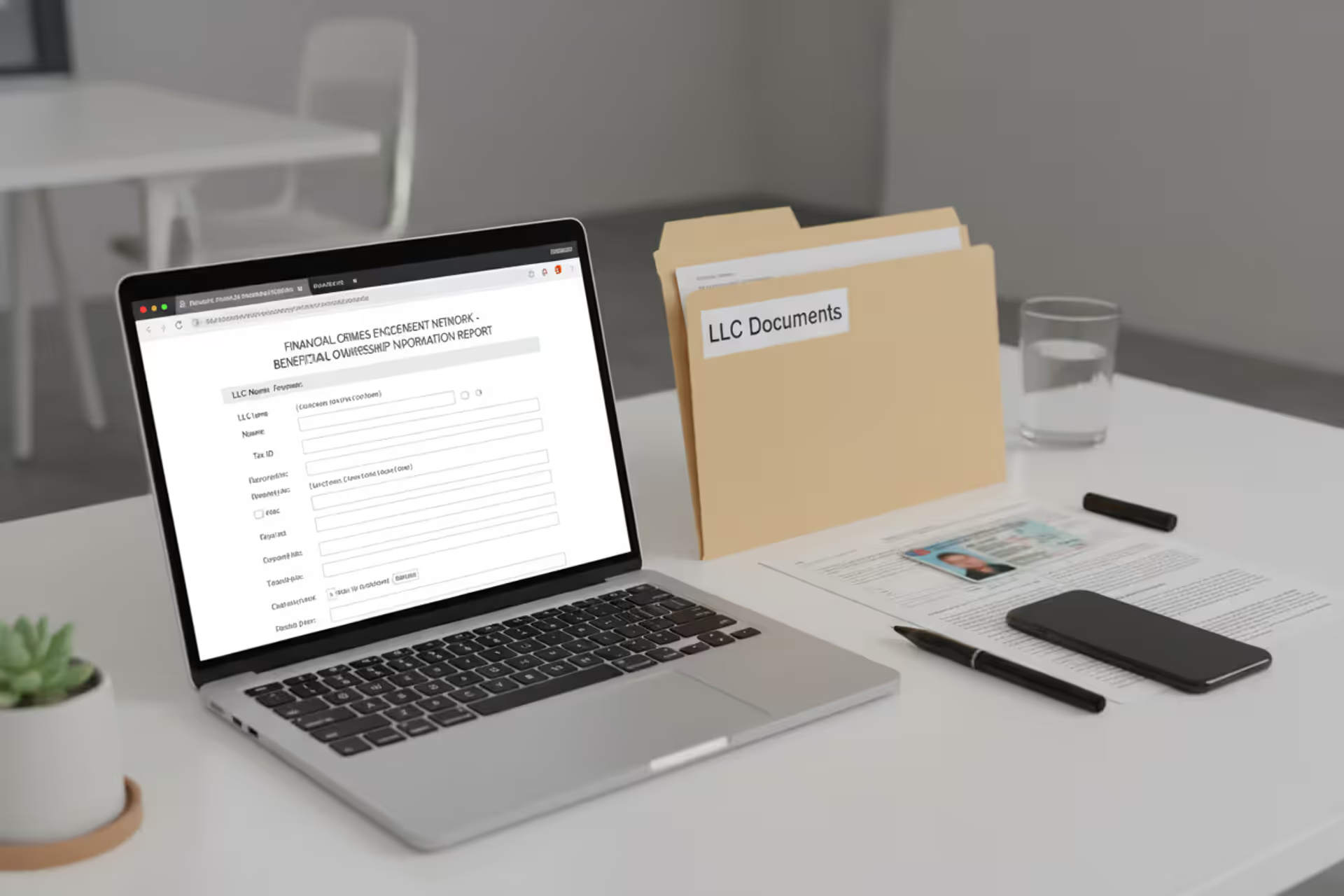
Business owner preparing an LLC beneficial ownership report online
What Is BOI Report for LLC and Who Must File

Content
Content
Got an LLC? There's a new federal filing requirement you need to know about, and it's catching thousands of business owners off guard.
The Corporate Transparency Act went live in 2024, bringing mandatory beneficial ownership reporting to nearly every LLC in America. Small businesses, side hustles, holding companies—size doesn't matter. If you've filed formation documents with your state, you're probably on the hook.
Here's what makes this urgent: Miss your filing deadline and you'll face $500 in penalties. Every single day. FinCEN (the federal agency running this program) isn't sending friendly reminder letters either. The penalties just accumulate automatically.
Yet most LLC owners we talk to have either never heard of BOI reporting or assume it doesn't apply to them. Wrong on both counts, usually.
This guide walks you through everything: who files, what information you'll need, how the online system works, and what happens if ownership changes down the road. We've also included the exemptions—though fair warning, they're narrower than most people hope.
Understanding the Beneficial Ownership Information Requirement
Why did Congress suddenly decide every LLC needs to report its owners to the feds?
Money laundering. Terrorism financing. Tax fraud. For decades, criminals used anonymous shell companies to hide dirty money. Someone in Moscow or Miami could create an LLC, never disclose who really owned it, and run illegal operations behind that corporate veil.
The Corporate Transparency Act aims to slam that door shut. Now there's a federal database tracking who actually owns and controls U.S. companies.
FinCEN—that's the Financial Crimes Enforcement Network, part of the Treasury Department—built and maintains this database. It's not public. You can't look up who owns your competitor's LLC. Access is restricted to law enforcement agencies, certain financial institutions conducting due diligence, and federal regulators under specific circumstances.
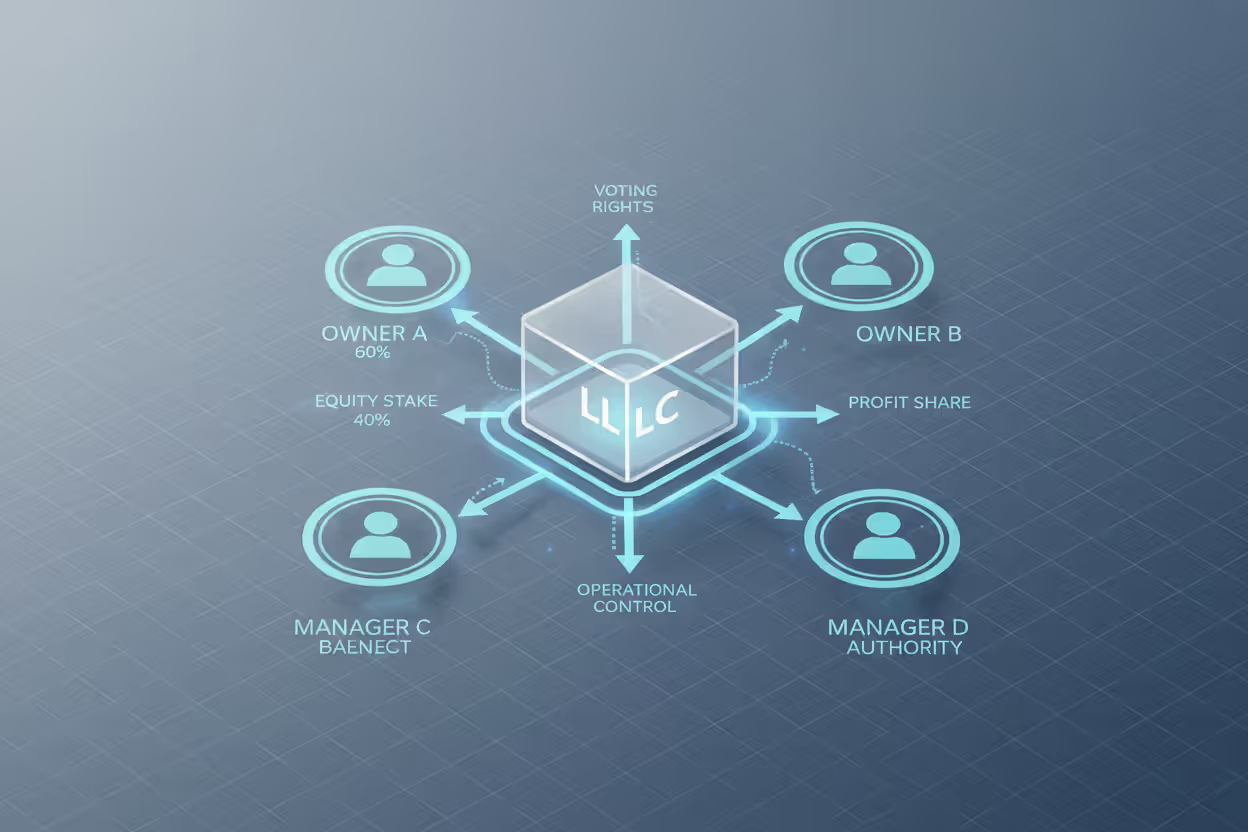
What exactly is beneficial ownership information llc? It's the real humans behind your company. Not the business name. Not the registered agent. The actual people who either own 25% or more of your LLC or control how it operates day-to-day.
For a typical two-member LLC, that's straightforward—report both members. For a manager-managed LLC where one person owns 100% but hires someone else to run operations? You're reporting both the owner and that manager.
One thing that trips people up: this isn't your annual state filing. Your Secretary of State report and your FinCEN BOI filing are completely separate. Different agencies, different deadlines, different purposes. Staying current with your state doesn't satisfy federal beneficial ownership llc requirements.
Author: Daniel Whitlock;
Source: worldwidemediums.net
Which LLCs Must File a BOI Report
Here's the default assumption: your LLC needs to file. Period.
Unless you clearly qualify for one of 23 specific exemptions (we'll cover those next), FinCEN expects a report from you. Doesn't matter if you're a single-member LLC or have ten partners. Doesn't matter if you made $10 or $10 million last year.
The law treats you as a "reporting company" if you filed formation documents with any U.S. state, territory, or tribal jurisdiction. That includes domestic LLCs formed here and foreign LLCs registering to do business in the United States.
Think you're off the hook because your LLC is just sitting there doing nothing? Think again. Dormant companies file. LLCs with zero revenue file. That holding company you set up three years ago and forgot about? Still needs to file.
These boi requirements for llc apply whether you're actively running a restaurant or just holding rental property in an otherwise inactive entity.
Common BOI Exemptions for LLCs
FinCEN created 23 exemption categories. Most benefit large corporations or heavily regulated financial companies. Small business LLCs? They rarely qualify.
But let's look at the exemptions that might actually apply to you:
Large operating company exemption: Your LLC skips filing if it checks ALL three boxes: more than 20 full-time employees working in the U.S., a physical office location in the U.S. where your team actually works, and over $5 million in gross receipts reported on last year's tax return. Miss even one of these criteria and you're filing. That $4.9 million company with 25 employees? Still filing.
Inactive entity exemption: This one's extremely narrow. Your LLC qualifies only if it existed before January 1, 2020, has never conducted any business operations, has zero foreign ownership, went through no ownership changes in the past year, sent or received $1,000 or less in the past year, and owns no assets of any kind (including stakes in other companies). Basically, it's for completely dormant entities that have been dormant since creation.
Subsidiary exemptions: When a company that's already exempt owns your LLC completely, your LLC might inherit exempt status. But your parent company needs to actually qualify for its own exemption first.
Certain regulated companies: LLCs registered as SEC-regulated investment advisers, FINRA broker-dealers, or certain other financial entities occasionally qualify. Your typical consulting LLC, retail shop, or service business won't fit here.
Let's be honest—if you're reading this article, your LLC probably doesn't meet any exemption. When in doubt, file anyway. There's no penalty for filing when you're actually exempt, but penalties for not filing when required are steep.
Do Single-Member LLCs Need to File
Yes. Absolutely yes.
The llc boi filing rules make no distinction between solo operations and multi-member companies. Your single-member LLC faces identical requirements.
You'll typically report yourself as the one beneficial owner. But here's a wrinkle: if you appointed someone else as manager in your operating agreement, and that manager makes significant business decisions, you're reporting them too—even though they own zero percent of the company.
What about disregarded entity status for tax purposes? Irrelevant. How the IRS classifies your single-member LLC has nothing to do with FinCEN's reporting requirements. They're different agencies enforcing different rules.
What Information Must Be Reported
Your beneficial ownership report for llc collects three categories of information: details about your company, identification for each beneficial owner, and (for newer LLCs) information about who filed your formation paperwork.
For your LLC itself, you'll report:
- Full legal name plus any DBAs or trade names you use
- Street address of your principal place of business (no P.O. boxes—FinCEN wants the actual location where you operate)
- The state or jurisdiction where you filed formation documents
- Your EIN from the IRS
For each beneficial owner, you need:
- Full legal name exactly as it appears on their government ID
- Date of birth
- Current home address (not a business address—your actual residence)
- An identification number from an acceptable document
- An image of that identification document
Acceptable IDs include current state driver's licenses, state-issued ID cards, U.S. passports, or foreign passports if the person has no U.S. identification options.

Author: Daniel Whitlock;
Source: worldwidemediums.net
Who counts as a beneficial owner? Two categories qualify:
First, anyone owning or controlling 25% or more of your LLC's ownership interests. Simple enough math for most small businesses.
Second, anyone exercising "substantial control" over your company's operations.
That substantial control definition is broader than you might think. It's not just about ownership percentages. You've got substantial control if you're a senior officer (president, CFO, general counsel, etc.), if you have authority to hire or fire senior officers, if you direct or significantly influence important business decisions, or if you exercise control through other means.
Here's a practical example: You own 60% of an LLC and your business partner owns 40%. You both report as beneficial owners based on ownership. But your partner also serves as managing member, making all operational decisions. Even if your partner only owned 10%, they'd still need to report based on that substantial control.
Company applicant information only applies to LLCs formed or registered on or after January 1, 2024. Company applicants are whoever directly filed your formation paperwork (often your lawyer or filing service) and whoever primarily directed that filing (typically you, the owner).
Most LLCs report one or two company applicants maximum.
Company applicants provide the same information as beneficial owners: name, birthdate, address, identification document. But here's the key difference—you report company applicant information once at initial filing and never update it. If a company applicant moves or gets a new driver's license, you don't file an update.
BOI Filing Deadlines and Penalties
Your deadline depends entirely on when you formed your LLC:
| LLC Formation Date | Filing Deadline | Notes |
| Formed before January 1, 2024 | Had to file by January 1, 2025 | All existing entities faced this single deadline |
| Formed during calendar year 2024 | 90 calendar days after formation | Transitional period for 2024 formations |
| Formed January 1, 2025 or after | 30 calendar days after formation | Current standard timeline |
Reading this in 2026? If your pre-2024 LLC hasn't filed yet, you're already accruing penalties. File immediately.
Companies created throughout 2024 got 90-day windows from their formation dates. File an LLC on March 15, 2024? Your deadline was June 13, 2024.
Starting in 2025, the window shrunk to just 30 days. Form an LLC on February 10, 2025, and you've got until March 12, 2025 to file.
Updates trigger new deadlines. Anytime previously reported information changes, you've got 30 calendar days to file an updated report.
Changes requiring updates include:
- A beneficial owner's name changes (marriage, legal name change, etc.)
- A beneficial owner moves to a new home address
- A beneficial owner gets a new ID document with a different number
- Your LLC gains or loses beneficial owners (new members, ownership transfers, control changes)
- Your LLC changes its legal name, adds or drops a DBA, or relocates its principal place of business
If you discover errors in a previous filing, you've got 30 days from discovering the mistake to file a correction.
Penalties for non-compliance aren't symbolic.
Civil penalties can hit $500 per day for every day your violation continues. Six months late? That's potentially over $90,000 in accumulated fines.
Criminal enforcement is authorized for willful violations—up to $10,000 in fines plus two years imprisonment. While FinCEN says criminal prosecution targets knowing violators, the statutory authority exists.
Here's what keeps small business owners up at night: senior officers face personal liability. If your LLC fails to file or submits false information, the managing member or manager can be personally penalized. Your LLC's limited liability protection doesn't shield you from BOI compliance failures.
Beneficial ownership reporting represents the biggest shift in small business regulatory compliance we've seen in a generation. Too many LLC operators assume they're somehow exempt or think they can postpone filing indefinitely, but enforcement is real and penalties accumulate fast. My firm advises immediate filing for every client, combined with calendar systems tracking update obligations—compliance costs far less than penalties
— Jennifer Martinez
How to File Your LLC's Beneficial Ownership Report
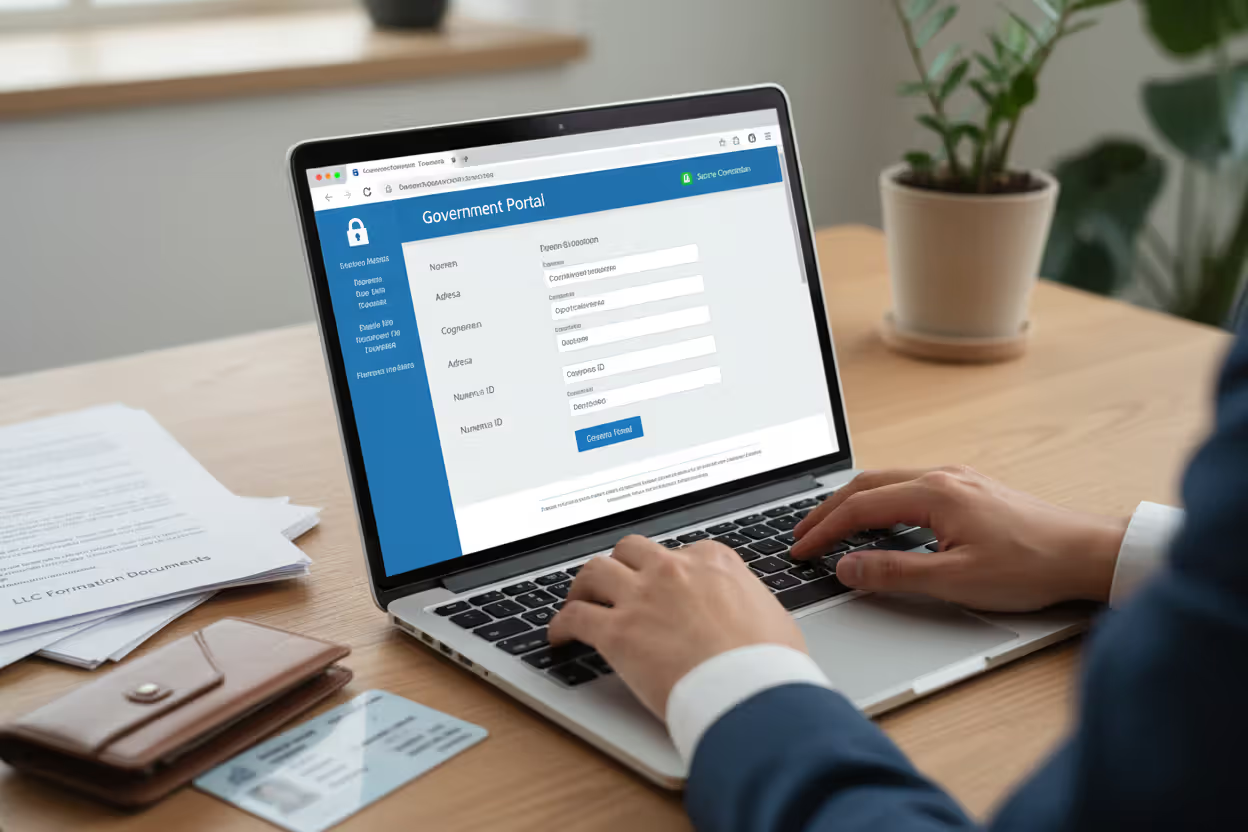
Filing happens entirely online through FinCEN's portal. They don't accept paper forms for BOI reporting.
The system is called BOSS—Beneficial Ownership Secure System. It's the only official filing channel.
Before you start, gather these items:
- Your LLC's formation documents and EIN confirmation letter
- Current government photo ID for every beneficial owner
- Home addresses for all beneficial owners (not business addresses)
- Birthdates for everyone reporting
- Digital copies or clear photos of all ID documents
Author: Daniel Whitlock;
Source: worldwidemediums.net
Here's the actual filing process:
Step 1: Go to fincen.gov/boi and click the "File BOIR" button. (BOIR stands for Beneficial Ownership Information Report.)
Step 2: Choose your report type—initial report for first-time filing, updated report for changes, or corrected report for fixing errors.
Step 3: Enter your LLC's basic information: legal name, any DBAs you use, formation state, physical business address, and EIN.
Step 4: Indicate any exemptions if applicable. (When uncertain, skip this and just file.)
Step 5: Click "Add Beneficial Owner" and complete every field for your first beneficial owner—full name, birthdate, residential address, ID details.
Step 6: Upload the ID document image or manually type the information from it.
Step 7: Repeat steps 5-6 for each additional beneficial owner.
Step 8: If your LLC formed on or after January 1, 2024, add company applicant information.
Step 9: Review everything carefully. Double-check addresses, birthdates, and name spellings.
Step 10: Submit the report.
You'll see a confirmation screen when successful. Save or screenshot this confirmation. FinCEN doesn't mail certificates, so this confirmation is your proof of filing.
Common mistakes that slow people down:
- Using business addresses instead of personal home addresses for beneficial owners
- Forgetting to report managers who have substantial control but don't own 25%
- Uploading blurry or expired ID photos
- Entering nicknames or shortened names instead of the full legal name on IDs
- Missing the 30-day update window after ownership changes
- Claiming exemptions without verifying every single criterion is met
Can you file yourself or do you need a lawyer? Most LLC owners handle their own filings just fine. The system is designed for regular business owners, not attorneys. Gather your information first and the actual filing takes 15-20 minutes.
Complex situations benefit from professional help—multi-layered ownership structures, foreign members without U.S. IDs, uncertainty about who qualifies as a beneficial owner. But straightforward LLCs rarely need paid assistance.
Also important: FinCEN charges zero fees for llc boi filing. It's completely free. If someone's asking for payment, they're a third-party service provider, not FinCEN. Some registered agent companies and legal document services offer paid filing assistance, but direct filing through FinCEN costs nothing.
Updating and Maintaining Your BOI Report
Filing once isn't enough. BOI compliance is ongoing.
Your LLC must file updated reports within 30 days whenever previously reported information changes.
Situations requiring updates:
Ownership changes: - A member sells their interest to someone else - You bring in a new partner who'll own 25% or more - An existing member buys out another member, changing ownership percentages - Someone joins your LLC in a management role with substantial control
Beneficial owner personal changes: - A member gets married and changes their legal name - A beneficial owner moves to a different home address - Someone renews their driver's license and gets a new license number - A beneficial owner's passport expires and they get a new one with a different number
Company changes: - Your LLC files a name change with your state - You register a new DBA or discontinue using an old one - You move your principal place of business to a different address - Your LLC gets assigned a new EIN (rare, but possible after certain restructurings)
Company applicant information never gets updated. Once you report it in your initial filing, it's locked in. Even if your formation attorney moves across the country or renews their ID, you don't file updates for company applicants.
The 30-day clock starts when the change actually happens, not when you find out about it. Member sells their interest on April 5th? Updated report is due May 5th, even if they didn't tell you until April 20th.
For address changes, the deadline runs from when someone actually moves into the new residence, not when they update their driver's license or stop mail forwarding.

Author: Daniel Whitlock;
Source: worldwidemediums.net
Record-keeping requirements:
Keep copies of your BOI filings and supporting documentation for five years after submission.
That includes the reports themselves plus the documents proving beneficial owner information—copies of IDs, proof of addresses, ownership records.
When you file updates, keep both the original filing and the updated version. Each filing starts its own five-year retention clock.
Why the record-keeping requirement? FinCEN can audit or investigate BOI submissions. Comprehensive records show you made good-faith compliance efforts if questions arise later.
Frequently Asked Questions About LLC BOI Filing
Beneficial ownership reporting changed the compliance game for American LLCs overnight. A law designed to catch international money launderers now affects millions of legitimate small businesses.
Your LLC almost certainly needs to file unless you clearly satisfy one of 23 exemptions—and most small companies don't. The good news? Filing costs nothing and takes about 20 minutes once you've gathered required information.
Collect government IDs for all your members and managers. Set aside half an hour. Log into FinCEN's portal and complete your filing.
Then set calendar reminders for updates. Ownership transfers, address changes, and name modifications all trigger 30-day update deadlines. Staying compliant matters as much as that initial filing.
The penalties for non-compliance are brutal. At $500 daily, even a few months of delay generates penalty amounts exceeding what most people spent forming their LLC. And remember—senior officers face personal liability. Your LLC's limited liability shield doesn't protect you from BOI penalties.
Haven't filed yet and your LLC existed before 2025? Your deadline has passed. File today to stop accumulating penalties. For newer LLCs formed in 2025 or later, you've got 30 days from formation—don't wait until day 29.
When you're uncertain about beneficial owner qualification or exemption eligibility, file anyway. FinCEN won't penalize you for filing while actually exempt, but they absolutely will penalize you for failing to file when requirements apply.
Related Stories

Read more

Read more




The content on this website is provided for general informational and educational purposes only. It is intended to explain concepts related to Limited Liability Companies (LLCs), including formation, management, taxation, compliance, and business structuring.
All information on this website, including articles, guides, templates, and examples, is presented for general educational purposes. LLC requirements and regulations may vary depending on individual circumstances, business activities, state laws, and jurisdiction.
This website does not provide legal, tax, or financial advice, and the information presented should not be used as a substitute for consultation with qualified legal, tax, or financial professionals.
The website and its authors are not responsible for any errors or omissions, or for any outcomes resulting from decisions made based on the information provided on this website.