

Small business owner workspace with tax documents and laptop
Single Member LLC Tax Guide for US Business Owners

Tax season turns most solo business owners into stressed-out zombies. Last March, a client walked into my office hauling receipts in a Target bag—literally a shopping bag—with zero clue she'd blown past three quarterly deadlines. She'd been running her consulting LLC for eighteen months.
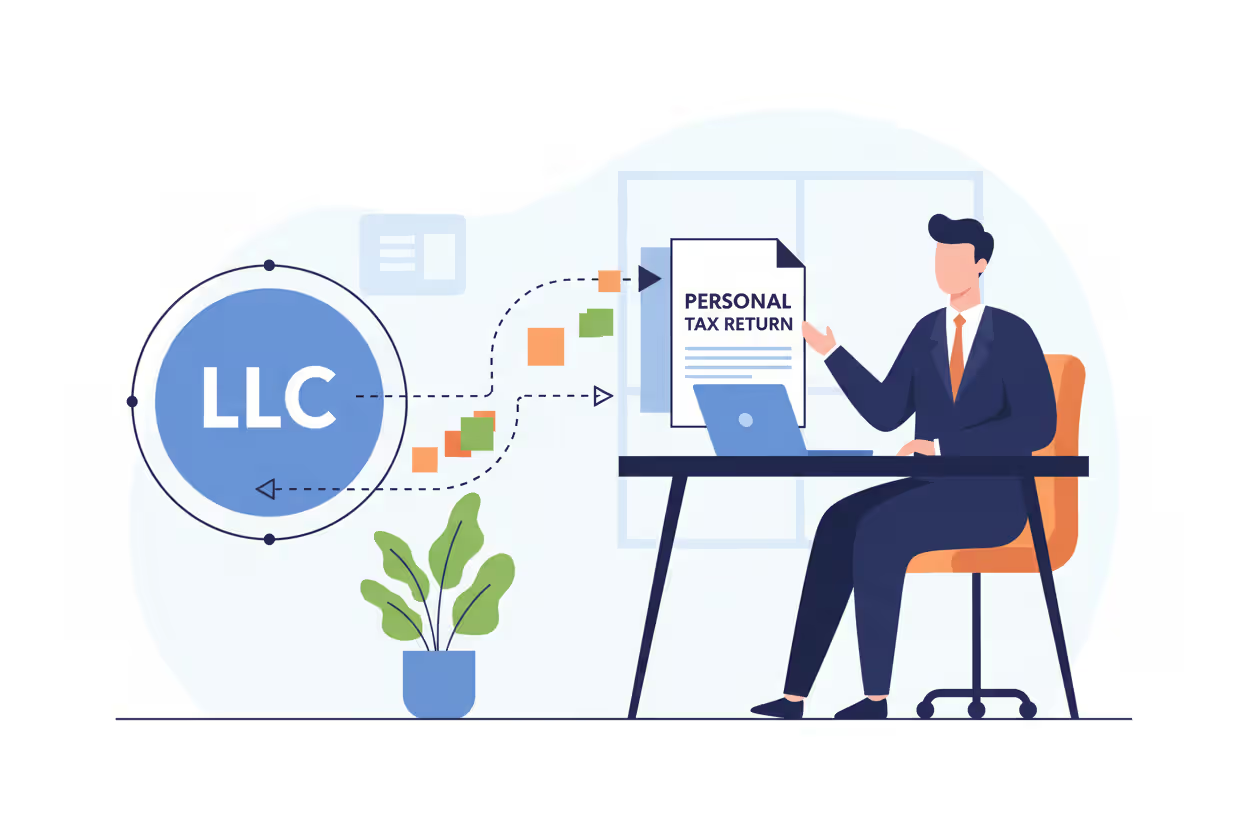
Here's what trips people up: the IRS basically pretends your LLC doesn't exist. You spent money forming this business entity, filed paperwork with your state, opened separate bank accounts—but come tax time, Uncle Sam treats your LLC like it's made of glass. They see straight through to you, the person running things, and tax you accordingly.
Most new LLC owners expect to file separate business returns. Wrong. Your LLC's money becomes your money (at least in the government's eyes), landing directly on your personal 1040. Sounds simple until you're staring at self-employment tax calculations or figuring out quarterly payments. Then add state rules that change every time you cross a border.
I wrote this to save you the confusion. You'll learn exactly which IRS forms to submit, whether you actually need that EIN everyone talks about, and which deductions knock serious money off your tax bill.
How Single Member LLCs Are Taxed by Default
The IRS calls your one-owner LLC a "disregarded entity." Fancy government speak for "we're ignoring your business structure."
Translation? Everything your LLC does financially—every invoice paid, every expense charged, every dollar earned—shows up on Schedule C, which attaches to your regular personal tax return. Schedule C is basically your business profit-and-loss statement in IRS format. You list what you earned up top, subtract your business costs in the middle, and what's left becomes your taxable income.
That leftover number matters more than you think. It determines not just your income tax, but triggers something most entrepreneurs forget about: self-employment tax.
Self-employment tax covers Social Security and Medicare. Regular employees split these costs 50/50 with their bosses. You're both employee AND employer, so you pay the full 15.3%—12.4% for Social Security (on your first $168,600 in 2026) plus 2.9% for Medicare (no cap on that one).
Make over $200,000 filing single, or $250,000 married? Tack on another 0.9% Medicare tax on earnings above those thresholds.
You calculate all this on Schedule SE, which then feeds into your main 1040. Your Schedule C profit becomes the starting point. The form crunches the numbers and tells you what you owe.
Unlike W-2 employees who never see this money (employers withhold it automatically), you're cutting the check yourself. Either one big payment when you file, or four smaller ones throughout the year—which we'll cover in a minute.
This happens automatically. No forms to file, no IRS notification needed. Form your LLC, start doing business, and boom—you're taxed this way unless you actively choose otherwise.
Author: Daniel Whitlock;
Source: worldwidemediums.net
Do You Need a Tax ID Number for Your Single Member LLC
Technically? No. The IRS lets you use your Social Security Number for tax filings when you're running solo without employees.
Realistically? Get an EIN immediately. Here's why.
Try opening a business bank account with just your SSN. Most banks will laugh you out the door—they want an EIN for business accounts. Plus, do you really want your Social Security Number floating around on vendor forms, client paperwork, and W-9s scattered across a dozen businesses? That's identity theft waiting to happen.
The IRS requires an EIN in specific situations: - You hire anyone (even one part-time helper) - You file excise tax returns for your industry - You pay wages to non-resident aliens with tax withholding - You elect to be taxed as an S-Corp or C-Corp - You run businesses involving employment, alcohol, tobacco, or firearms taxes
Getting one costs nothing. The online IRS application takes maybe ten minutes. You receive your nine-digit number immediately. (Mail and fax options exist but take weeks—skip those.)
Your EIN sticks with your LLC permanently. No annual renewals, no updates needed unless you restructure as a partnership or corporation.
Save that confirmation letter somewhere safe. You'll need that number constantly—tax forms, bank applications, business licenses, every W-9 you hand to clients.

Author: Daniel Whitlock;
Source: worldwidemediums.net
One catch: old EINs from previous businesses probably won't work for your current LLC. The IRS ties EINs to specific entities. Call their business helpline if you're unsure whether your existing number applies.
Required Tax Forms for Single Member LLC Filing
Everything centers on Schedule C—officially "Profit or Loss from Business (Sole Proprietorship)." This two-page form captures your entire business year.
Part I covers income: total receipts from customers, returns and allowances you gave, plus cost of goods sold if you're selling physical products. Part II lists expense categories: advertising, car and truck expenses, insurance, legal and professional fees, rent, supplies, utilities, wages paid, and about fifteen more. Part V handles "other expenses" that don't fit the predefined boxes.
A shorter version exists (Schedule C-EZ) but applies to almost nobody. You'd need business expenses under $5,000, no inventory, no employees, cash-method accounting, and no prior passive loss carryovers. Most single-member LLCs fail multiple requirements.
After Schedule C, you tackle Schedule SE for self-employment tax. It takes 92.35% of your net business profit (accounting for the employer portion of SE tax), then applies the tax rates I mentioned earlier.
State requirements vary wildly. California charges an annual LLC fee based on gross income—$800 minimum, jumping to $11,790 if you gross over $5 million. New York wants Form IT-204-LL from single-member LLCs. Texas has no income tax but hits LLCs with franchise tax above certain revenue thresholds. Check your state's Department of Revenue website—generic advice won't cut it.
Filing as an S-Corp or C-Corp Instead
Your LLC can ditch disregarded entity status by electing corporate tax treatment. File Form 2553 for S-Corp treatment, or Form 8832 to become a C-Corp.
S-Corp status attracts profitable LLCs because it slashes self-employment tax. Here's how: you become an official W-2 employee of your own business, paying yourself a "reasonable salary" subject to normal payroll taxes. Profits beyond your salary pass through as distributions, which completely dodge self-employment tax.
The IRS watches "reasonable salary" closely. Pay yourself $30,000 while taking $200,000 in distributions? Expect problems. Industry standards, your experience level, and comparable roles all factor into acceptable ranges.
S-Corp treatment adds complexity and cost. You'll run payroll (even for yourself), file quarterly 941 forms, complete an annual 1120-S return, issue yourself a K-1, and probably pay an accountant $1,500-$3,000 yearly to manage everything. The math usually favors this route once net profit hits $70,000-$80,000.
C-Corp elections rarely help single-member LLCs. You face double taxation—the corporation pays tax on profits, then you pay tax again receiving dividends. Specific situations like raising venture capital or retaining large cash reserves might warrant this, but most solo operations gain nothing.
| Feature | Default (Schedule C) | S-Corporation Election |
| Tax treatment | IRS ignores the entity; owner reports all activity on personal return | Separate tax entity; files its own return and issues K-1 to owner |
| Forms required | Schedule C, Schedule SE, personal 1040 | Form 1120-S (annual), payroll tax forms (quarterly), W-2 and K-1 to owner |
| Self-employment tax | Applies to entire net profit | Only wages face payroll tax; distributions escape it |
| Complexity | Simple enough for DIY with TurboTax | Needs professional help; payroll setup; quarterly deadlines |
| Best for | New businesses under $60K profit; owners wanting simplicity | Established businesses over $70K profit; owners accepting more paperwork |
Estimated Quarterly Tax Payments
American taxes work on a pay-as-you-go system, not just once in April. Since nobody withholds from your business income, you're making estimated payments four times yearly using Form 1040-ES.
The 2026 payment schedule: - April 15 (covers January-March) - June 16 (covers April-May) - September 15 (covers June-August) - January 15, 2027 (covers September-December)
Quarterly estimates kick in when you'll owe $1,000 or more at filing time. Calculate this by projecting annual income, finding your tax bracket, adding self-employment tax, then dividing by four.
Skip these payments and you'll hit underpayment penalties—currently the federal short-term rate plus three percentage points. Safe harbor rules protect you: pay at least 90% of your current year tax, or 100% of last year's total tax (110% if prior year AGI topped $150,000), and penalties disappear even if you underpay.
Tax software calculates your quarterly obligation when you file. I recommend bumping that up 10-15% if your income swings around. Better to get a refund than scramble for penalty money.

Author: Daniel Whitlock;
Source: worldwidemediums.net
Step-by-Step Single Member LLC Tax Return Process
Mark April 15, 2027 on your calendar—that's when your 2026 return is due. Falls on a weekend? Deadline shifts to the next Monday. Need more time? File Form 4868 by April 15 for an automatic extension to October 15. Key point: extensions delay your filing deadline, not your payment deadline. Taxes still accrue interest and penalties if not paid by April 15.
Start gathering documents in late December or early January. Collect: - Full year of bank statements showing deposits and charges - Receipts for every deductible expense (seriously, every one) - Mileage logs if claiming vehicle deductions - 1099-NEC forms from clients (they must send by January 31) - Records of quarterly estimated payments you've made - Last year's return for carryover items and reference
Begin with income. Total everything your LLC received—credit card deposits, checks, cash, digital payments through PayPal or Venmo. Cross-check your 1099s against your records. Found a mismatch? Contact that client before filing. The IRS receives copies of all 1099s and their computers automatically flag discrepancies.
Next, categorize expenses into Schedule C buckets. The form has specific lines for advertising, car expenses, insurance, legal fees, office expense, rent, supplies, utilities, plus an "other expenses" section for stuff that doesn't fit. Proper categorization matters—the IRS uses expense ratios to flag potential audits. Home-based consultants showing $40,000 income and $18,000 vehicle expenses will raise eyebrows.
If you sell physical goods, calculate cost of goods sold. This captures what you paid for inventory or materials, reducing taxable income by the direct cost of items sold.
Transfer your Schedule C net profit to Schedule SE. That form calculates self-employment tax, which flows to Schedule 2 of your 1040. Your business income shows on Schedule 1, Line 3.
Common mistakes causing headaches: - Putting gross income on wrong 1040 lines (use net profit, not total sales) - Forgetting Schedule SE entirely and missing self-employment tax - Mixing personal and business expenses (your grocery run doesn't count even if you bought office snacks) - Excessive round numbers (the IRS prefers actual amounts, not estimates) - Using your LLC name instead of your personal name on Form 1040 - Ignoring state filings or city business taxes
Make sure your EIN appears on Schedule C if you have one. But remember: Form 1040 itself needs your Social Security Number, not your business EIN. The LLC doesn't file a separate federal return under default classification.
Tax Deductions Available to Single Member LLCs
Single-member LLCs get the same deductions available to sole proprietors. The rule: expenses must be "ordinary and necessary" for your business. Ordinary means common in your industry. Necessary means helpful and appropriate, though not absolutely required.
Home office deductions work when you use part of your residence exclusively and regularly for business. Two calculation methods exist. Simplified method multiplies your office square footage by $5 (capped at 300 square feet, so $1,500 max). Regular method figures your home's business-use percentage, then applies that to mortgage interest, property taxes, insurance, utilities, repairs, and depreciation. Simplified is faster; regular usually yields bigger deductions.
Vehicle expenses follow either the standard mileage rate (70 cents per mile for 2026) or actual expense method (gas, maintenance, insurance, registration, depreciation times your business-use percentage). Standard mileage favors high-mileage, efficient cars. Actual expenses favor expensive vehicles with lower mileage. Track every business trip: date, starting point, destination, business purpose, miles driven. Apps like Everlance or MileIQ automate this with GPS.
Health insurance premiums for yourself, spouse, and dependents go on Form 1040 Schedule 1 (not Schedule C) when you show net profit and can't access coverage through a spouse's employer. This cuts your income tax but won't reduce self-employment tax.
Startup costs cover expenses before your LLC began operating. Deduct up to $5,000 in year one if total startup costs stayed under $50,000. Qualifying expenses include market research, hiring consultants, developing your business plan, and pre-opening advertising. Amounts over $5,000 get amortized over 15 years.
Other valuable deductions: - Professional fees (attorneys, accountants, business coaches) - Business insurance (general liability, E&O, property, umbrella) - Software subscriptions (accounting tools, project management, design programs) - Office supplies and equipment purchases - Education (courses, conferences, certifications related to your work) - Business meals when traveling or meeting clients (50% deductible) - Advertising and marketing (digital ads, website costs, promotional items) - Contract labor and employee wages you paid - Commercial rent or coworking space - Depreciation on equipment over its useful life
I've reviewed hundreds of single-member LLC tax returns over the past decade. The pattern never changes: owners who track expenses in real-time save 40-60% more in taxes than those who reconstruct everything at year-end. Most entrepreneurs don't realize how many small charges add up—$47 for software, $23 for office supplies, $89 for a client lunch. Individually tiny, but collectively these represent thousands in missed deductions. Get Expensify, QuickBooks, or even just a dedicated credit card that you reconcile weekly. That discipline alone typically saves my clients ten times what the tracking tool costs
— Marcus Chen
Section 179 expensing lets you deduct equipment purchases immediately instead of depreciating them. Rather than depreciating a $15,000 computer system over five years, deduct it all now. For 2026, Section 179 allows up to $1,220,000 in deductions for equipment purchases under $3,050,000 total. This helps single-member LLCs making significant equipment investments.
Retirement contributions through SEP-IRAs, Solo 401(k)s, or SIMPLE IRAs reduce current taxable income while building your retirement savings. SEP-IRA contributions reach up to 25% of your net self-employment income (after deducting half your self-employment tax), maxing at $69,000 for 2026. Solo 401(k)s offer more flexibility with employee and employer contribution buckets.
Common Single Member LLC Tax Mistakes and How to Avoid Them
Mixing personal and business spending creates nightmares and attracts IRS attention. Separate bank accounts aren't optional—they're essential. Open a business account (many banks offer free small business checking) and run every LLC transaction through it. Get a business credit card for purchases. This separation protects your liability shield and makes expense tracking automatic.
Skipping quarterly estimated payments costs real money. Underpayment penalties plus interest can add 5-8% to your tax bill. Set phone reminders for each quarterly deadline. Better yet: automatically transfer 25-30% of each client payment into a separate tax savings account. When quarterly deadlines arrive, you've already got the cash.

Author: Daniel Whitlock;
Source: worldwidemediums.net
Misclassifying workers triggers expensive penalties. Bringing on help means deciding: employee or independent contractor? The distinction matters enormously. The IRS examines behavioral control (do you direct how they work?), financial control (can they profit or lose?), and relationship type (contracts, benefits, permanency). Get this wrong and you face back payroll taxes, penalties, and interest on every payment you should've withheld. When in doubt, classify as employee—it's safer.
Inadequate documentation kills deductions during audits. The IRS wants proof of amount, date, place, and business purpose for each expense. Credit card statements alone won't cut it. Keep itemized receipts, especially for meals, entertainment, travel, and vehicle use. Snap photos of receipts with your phone immediately and save to cloud storage. Apps like Expensify, Shoeboxed, or Receipt Bank make this painless.
Claiming disproportionate vehicle deductions invites scrutiny. Show $35,000 business income and $18,000 car expenses? Expect questions. Maintain detailed mileage logs showing total annual miles and business miles separately. The IRS can (and will) disallow your entire vehicle deduction when you can't produce contemporaneous mileage records.
Deducting hobby losses violates tax law. The IRS presumes you're running a real business when you show profit in three of five consecutive years. Claiming losses year after year without demonstrating profit motive through business-like operations, relevant expertise, significant time investment, and reasonable profit expectation will reclassify your venture as a hobby. Hobby expenses can't exceed hobby income, and you'll owe back taxes plus penalties.
Filing late without an extension triggers failure-to-file penalties at 5% of unpaid taxes per month, maxing at 25%. Even when you can't pay the full tax owed, file on time. The failure-to-pay penalty runs just 0.5% monthly—ten times smaller. Submit your return by the deadline, then set up a payment plan with the IRS for what you can't immediately pay.
Neglecting state and local taxes creates compliance problems. Beyond income tax, many states charge franchise taxes, gross receipts taxes, or annual LLC fees. Cities often require business licenses or municipal tax returns. Counties may have personal property tax on business equipment. Research requirements for every jurisdiction where you maintain a presence or earn revenue—rules shift dramatically across state lines.
Frequently Asked Questions About Single Member LLC Taxes
Handling taxes for your single-member LLC demands year-round attention and organized records, not just a frantic April scramble. The disregarded entity setup simplifies filing compared to corporations while preserving access to business deductions that meaningfully cut your tax bill.
Build systems in January that prevent April panic. Whether you choose QuickBooks, FreshBooks, Wave, or a simple spreadsheet, commit to recording every transaction when it happens. Maintain separate business accounts. Photograph receipts immediately. Pay quarterly estimated taxes on schedule. These habits eliminate the yearly scramble to reconstruct your finances from memory and crumpled papers.
Consider hiring a CPA or enrolled agent, especially for your first year or once annual income crosses $75,000. Professional fees typically run $500-$2,000 depending on complexity, but the investment usually returns multiples through legitimate tax savings, strategic planning, and audit protection. A skilled tax pro also helps you prepare for growth and identify when elections like S-Corp status make sense.
Tax strategy evolves as your business grows. What works at $40,000 yearly income needs adjustment at $120,000. Review your tax situation every December. Ask: Should I elect S-Corp treatment? Am I maximizing retirement contributions? Have I captured all available deductions? Would hiring help increase income enough to justify added payroll complexity?
The tax code includes legitimate opportunities to reduce what you owe through deductions, credits, retirement savings, and strategic planning. Taking advantage of these benefits while maintaining proper records and compliance brings both peace of mind and extra cash to reinvest in growing your business. Start with solid systems, stay on top of deadlines, and adjust your approach as your LLC evolves.
Related Stories

Read more

Read more



The content on this website is provided for general informational and educational purposes only. It is intended to explain concepts related to Limited Liability Companies (LLCs), including formation, management, taxation, compliance, and business structuring.
All information on this website, including articles, guides, templates, and examples, is presented for general educational purposes. LLC requirements and regulations may vary depending on individual circumstances, business activities, state laws, and jurisdiction.
This website does not provide legal, tax, or financial advice, and the information presented should not be used as a substitute for consultation with qualified legal, tax, or financial professionals.
The website and its authors are not responsible for any errors or omissions, or for any outcomes resulting from decisions made based on the information provided on this website.